3-on-6 dental implants place six implants in one jaw to hold three separate bridges, according to the 3 on 6 program. The FDA says implant healing may take several months. The program describes about three months before final teeth. A 2018 review of 93 studies found similar survival with fewer or more implants per jaw. Candidacy depends on health, gums and jawbone, according to the FDA.
Key Takeaways
- The 3 on 6 program describes six implants and three segmented bridges per jaw.
- A 2018 review in Clinical Oral Implants Research found no significant survival difference between fewer than five and five or more implants.
- The FDA says healing after implant placement may take several months or longer.
- A 2019 review reported 96.4% implant survival at 10 years.
- The FDA lists smoking, uncontrolled diabetes and untreated gum disease as factors that raise implant risk.
What Are 3-On-6 Dental Implants and How Do They Work?
3-on-6 dental implants are a full-arch design with six implants supporting three separate bridges, according to the 3 on 6 program. Each bridge replaces a section of the arch. The program describes zirconia final teeth. The 3-on-6 layout differs from a single bridge that spans the whole jaw.
Our doctors explain how implant placement works for each jaw before any treatment starts. The exam covers the remaining teeth, the gums and the jawbone. That plan decides how many implants a jaw can support.
The National Institute of Dental and Craniofacial Research (NIDCR) reports that adults age 20 to 64 average 26 of 32 teeth. About 2% of those adults have no natural teeth. About 17% of adults age 65 and older have no teeth. These figures set the context for full-arch replacement, which leads to the parts of an implant.
What Is a Dental Implant Made Of?
A dental implant is made of titanium or zirconium oxide in most systems, according to the U.S. Food and Drug Administration (FDA). The implant body is placed in the jawbone in place of the tooth root. An abutment extends through the gum to support the artificial teeth.
The American College of Prosthodontists describes implants as titanium cylinders that support single crowns, large bridges and dentures. In a 3-on-6 plan, each bridge attaches to implants through these abutments. The next section compares that design with All-on-4.
Which Is Better, All-on-4 or 3 on 6 Dental Implants?
Neither All-on-4 nor 3 on 6 dental implants has shown better results, according to a 2018 review in Clinical Oral Implants Research. Survival was similar with fewer or more implants per jaw. The review covered 93 studies with a median follow-up of 8 years.
The review compared fewer than five implants with five or more. The review found no significant difference in implant or prosthesis survival (p greater than 0.05). A 2023 cohort study in Clinical Implant Dentistry and Related Research reached a similar result. The study followed 217 patients with 1,222 implants for 3 to 13 years. That study found no significant difference between four and six implants.
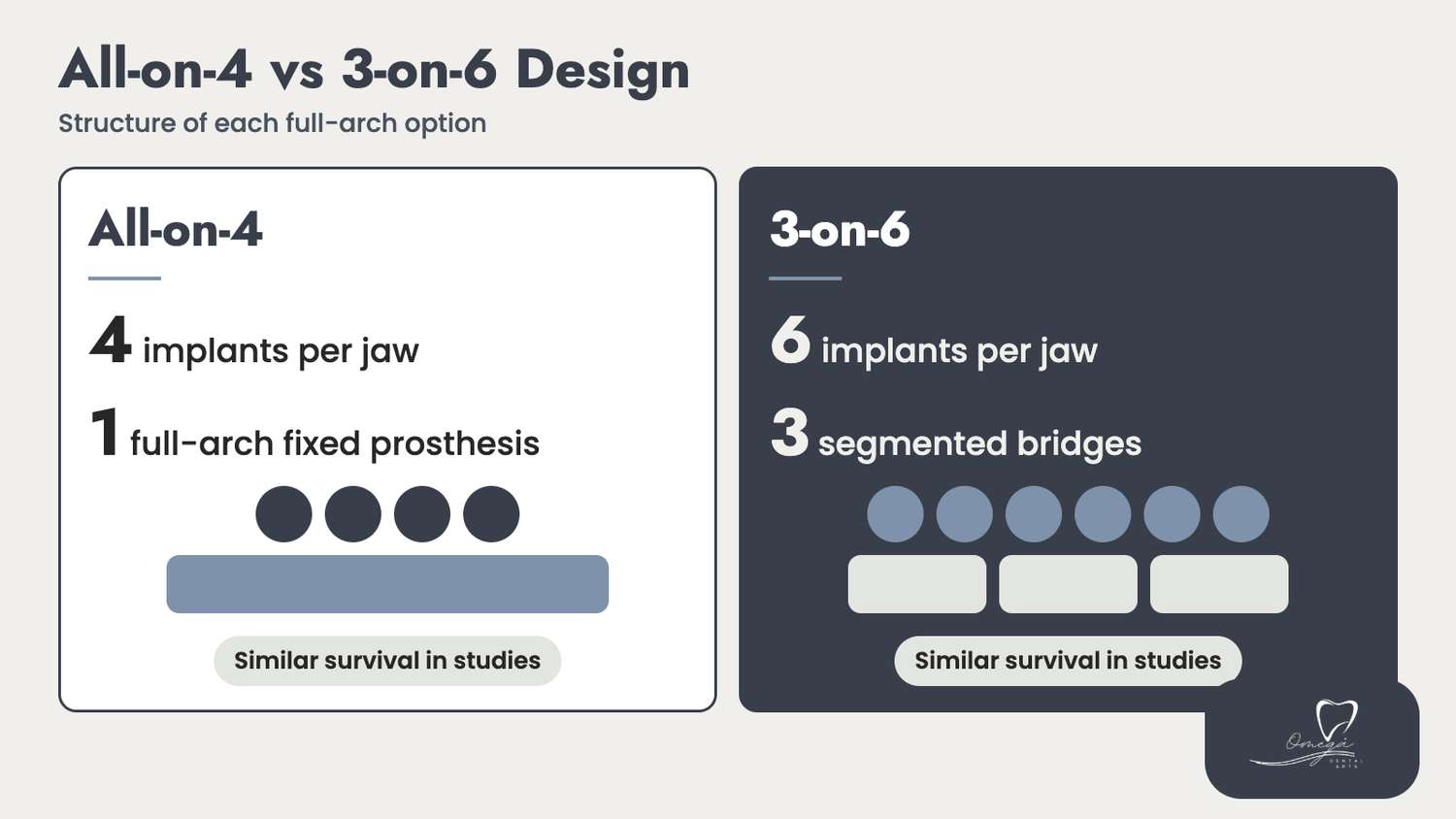
The table below lists how the two designs differ in structure, based on those studies and the 3 on 6 program.
| Feature | All-on-4 | 3-on-6 |
|---|---|---|
| Implants per jaw | 4 | 6 |
| Prosthesis | One full-arch fixed prosthesis | Three segmented bridges |
| Survival in studies | No significant difference from six implants | No significant difference from four implants |
| Final tooth material | Varies by prosthesis | Zirconia, per the 3 on 6 program |
The table shows that the main difference is structure rather than proven survival. The graphic below summarizes the same comparison.
Do More Implants Mean Longer-Lasting Teeth?
More implants did not change survival in the 2018 review. The review found no significant difference between fewer than five and five or more implants. The most reported count was four upper-jaw implants in the fewer-than-five group. The five-or-more group most often used six upper-jaw implants.
These results come from studies of fixed full-arch prostheses in general. The review did not test the 3-on-6 bridge design on its own. The next section covers how long treatment takes.
How Long Does It Take to Get 3 on 6 Dental Implants?
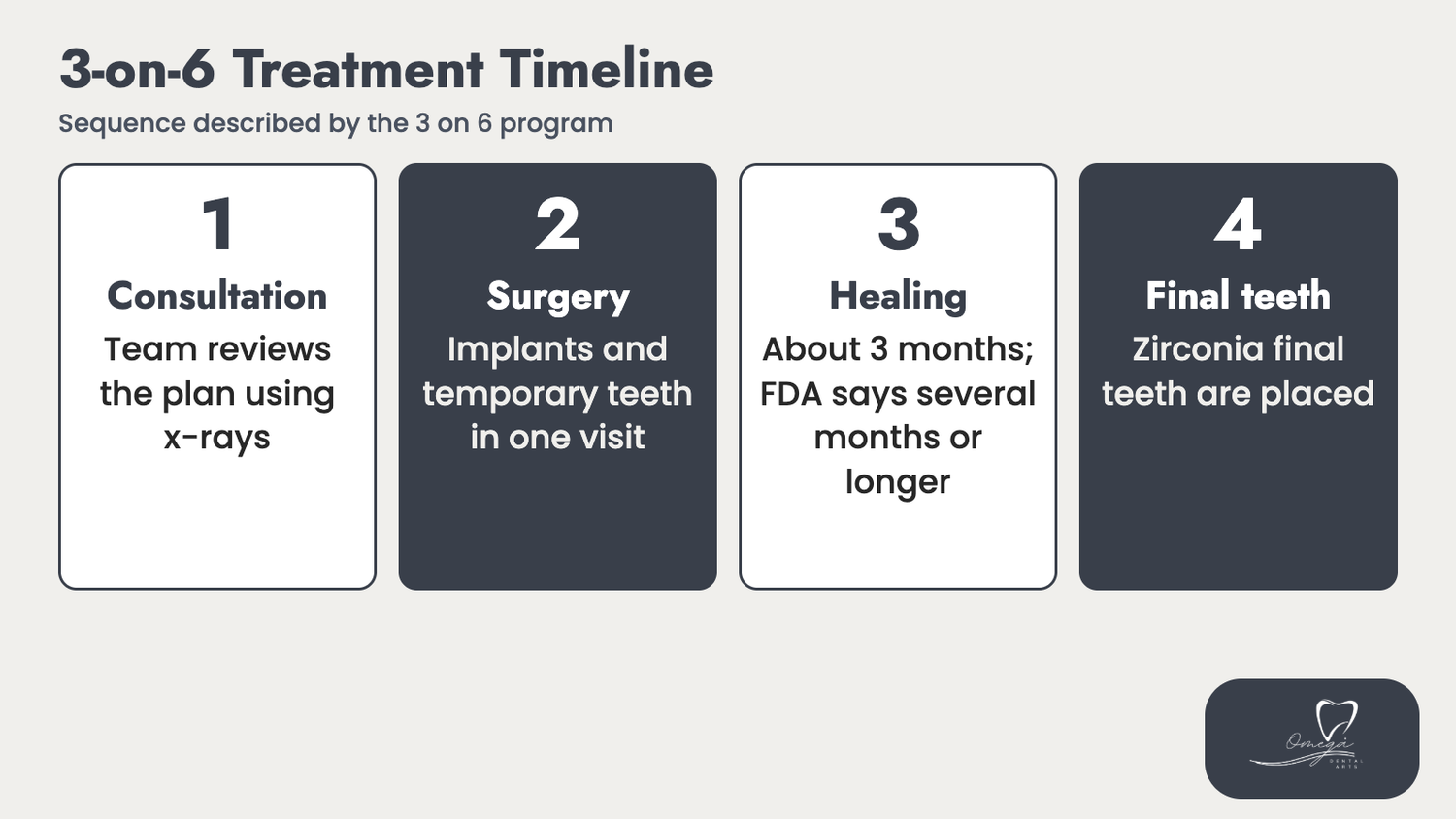
Getting 3 on 6 dental implants takes about three months of healing before final teeth, the 3 on 6 program says. Surgery places the implants and temporary teeth in one visit. The FDA says healing after implant placement may take several months or longer.
The steps below follow the sequence the program describes, plus the FDA follow-up advice.
- Attend a consultation where the team takes x-rays and reviews the plan.
- Receive the implants and temporary teeth during one surgical visit.
- Follow the oral hygiene instructions during healing, as the FDA advises.
- Return after about three months of healing for zirconia final teeth.
- Schedule regular visits so the dentist can check the implants.
Patients can see each stage in our implant steps article. The graphic below shows the same timeline.
How Long Does It Take for All on 6 Dental Implants to Heal?
All on 6 dental implants take several months or longer to heal, according to the FDA. Overall health affects how long healing takes. The FDA adds that smoking may delay healing and lower long-term success.
A dentist checks healing at follow-up visits, and our implant aftercare article covers daily care. Pain, looseness or a bite that feels off should be reported right away, as the FDA advises. Pain is the next common question.
How Painful Is All on 6 Dental Implants?
Pain after all on 6 dental implants is managed with medication. NSAIDs significantly reduced post-operative pain compared with placebo in a 2021 review of nine randomized trials. The review appeared in Clinical Oral Investigations and covered pain after implant placement.
Pain levels differ from patient to patient. Our implant discomfort article explains what recovery feels like. The dentist chooses the pain plan for each case.
How Long Do 3 on 6 Dental Implants Last?
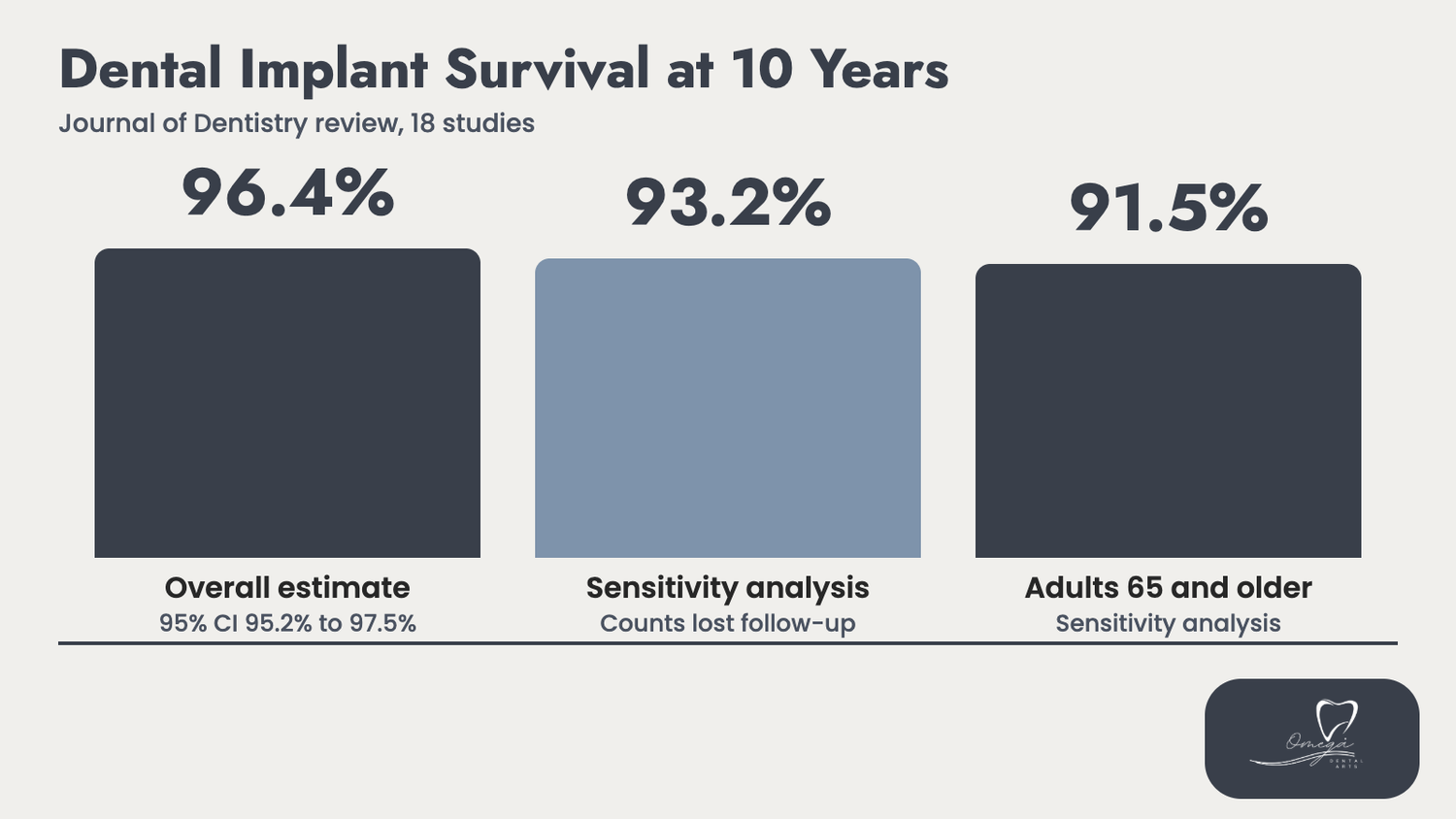
3 on 6 dental implants have no published lifespan of their own. Implants in general showed 96.4% survival at 10 years in a 2019 review in the Journal of Dentistry. That review pooled 18 studies and reported a 95% confidence interval of 95.2% to 97.5%.
The same review ran a stricter sensitivity analysis that counted patients lost to follow-up. That analysis gave 93.2% survival at 10 years. The review also found lower survival, 91.5%, in adults age 65 and older. The graphic below shows these three figures.
Survival depends on care as well as design. The FDA says regular cleaning of the implant and surrounding teeth is very important for long-term success. Our implant lifespan article covers the factors in more detail.
Who Is a Good Candidate for 3 on 6 Dental Implants?
A good candidate for 3 on 6 dental implants has health that supports surgery and healing, says the FDA. The FDA names overall health as an important factor in candidacy. A dental provider reviews the benefits, the risks and the jawbone before recommending a design.
The factors below affect that review, according to the FDA and published studies.
- Smoking was linked to higher implant failure, with a relative risk of 1.92 across 51 studies in PLoS One in 2013.
- The FDA says failure from systemic infection may be more likely with uncontrolled diabetes.
- Diabetes showed no significant link to failure in the same 2013 analysis, with a relative risk of 0.90.
- The FDA lists untreated periodontal disease among the risks to an implant.
- The 3 on 6 program says the team takes x-rays at the first visit to plan treatment.
Our implant candidacy article explains how the dentist weighs these points. The next questions cover specific disqualifiers.
What Disqualifies You From Dental Implants?
What disqualifies you from dental implants is decided by a dental provider. The FDA names uncontrolled diabetes, smoking and untreated periodontal disease as conditions that raise implant risk. The FDA does not list one automatic disqualifier. The agency advises patients to review candidacy with a dental provider.
A 2006 meta-analysis of 19 studies found an odds ratio of 2.17 for implant failure in smokers. A 2016 review of 14 studies found no difference in failure counts between people with and without diabetes. That review did find more marginal bone loss in people with diabetes.
Who Do Dental Implants Suit?
Dental implants suit adults who have lost teeth, and the FDA names injury or disease as the cause of that loss. The American College of Prosthodontists adds decay too extensive to restore, cleft lip, teeth fractured by grinding and ill-fitting dentures.
The ACP says a prosthodontist helps decide whether implants fit a patient's goals. Age is another common concern.
At What Age Should You Stop Getting Dental Implants?
No age cutoff for dental implants appears in FDA guidance, which says overall health is an important factor in candidacy. The 2019 review found 91.5% implant survival at 10 years in adults age 65 and older. That figure came from its sensitivity analysis.
That figure is lower than the 96.4% for all adults. The review described a possible doubling of implant loss risk in older age groups. A dentist weighs health and bone rather than birthdays.
Can I Have All My Teeth Pulled and Get Implants?
Yes, teeth that cannot be restored can be removed and replaced with implants. The ACP says decay can be too extensive to restore. The dentist decides which teeth to remove after an exam. Extraction and implant timing then follow the healing plan.
Natural teeth that can be restored are not removed without cause. The extraction decision comes first, which leads to the risks of full-arch implants.
What Are the Disadvantages of All on 6 Dental Implants?
The disadvantages of all on 6 dental implants include surgery, months of healing and a risk of complications, according to the FDA. The FDA lists sinus injury, nerve numbness, a loose abutment screw and implant failure among the possible complications.
The FDA also notes that complications can occur soon after placement or much later. The signs below are the ones the FDA tells patients to report.
- An implant that feels loose or painful.
- A bite that does not feel normal.
- Numbness after surgery.
- Gums that are hard to clean around the implant.
Gum infection around implants is a late complication. A 2022 review in BMC Oral Health found peri-implantitis in 19.53% of patients and 12.53% of implants across 57 articles. Patients who notice swelling or bleeding should call their dentist.
What Else Should You Know About 3-On-6 Dental Implants?
How Much Does 3 on 6 Dental Implants Cost?
The cost of 3 on 6 dental implants depends on the number of implants, imaging, extractions, sedation and the final tooth material. A dentist gives a written estimate after the exam. Our implant insurance article explains how coverage questions are handled.
Is There Anything Better Than Dental Implants?
No single option is better than dental implants for every patient. The right choice depends on health, bone and goals, according to the American College of Prosthodontists. Dentures and bridges are the main alternatives. Our denture comparison lays out the differences.
Is It Better to Pull a Tooth or Get an Implant?
Pulling a tooth comes first only when the tooth cannot be restored, according to the American College of Prosthodontists. The ACP says decay can be too extensive for a filling. An implant then replaces the root after the extraction and healing.
Who Does Dental Implants?
A licensed dental provider does dental implants, and the FDA tells patients to ask which brand and model the provider uses. Patients should keep that information in their records. Patients with several missing teeth can read about multiple missing teeth and the options for them.
Are Dental Implants Safe?
Dental implants are evaluated against international standards before sale, according to the FDA. Manufacturers must show the FDA that their systems are as safe and as effective as systems already on the market. Complications can still occur, so follow-up visits matter.
Frequently Asked Questions
Should I Get Dental Implants?
Whether you should get dental implants is a decision for you and a dental provider. The FDA advises reviewing benefits, risks and candidacy before choosing. The FDA lists restored chewing and healthier bone among the benefits. Complications are the main risk.
Why Get Dental Implants?
People get dental implants to restore chewing and help keep the jawbone from shrinking, according to the FDA. The FDA also lists restored appearance and stable neighboring teeth. These benefits explain why dental implants are chosen over removable options.
What Is the Healthiest Dental Implant to Get?
The healthiest dental implant is one made of titanium or zirconium oxide that meets FDA standards, because most systems use those materials. The FDA says systems follow ISO or ASTM standards and biocompatibility testing. A dentist chooses the system for each patient.
What Is the Downside of Having Dental Implants?
The downside of having dental implants is possible complications and a months-long healing period, according to the FDA. Smoking and uncontrolled diabetes raise the risk. Regular cleaning and checkups lower the chance of problems.
Should I Get All My Teeth Pulled and Get Implants?
Whether to have all teeth pulled and replaced with implants depends on the exam. Teeth that can be restored are kept by the dentist. The American College of Prosthodontists names unrestorable decay as one reason for extraction.
How Does Omega Dental Arts Help With Dental Implants?
Omega Dental Arts helps patients with dental implants through exams, imaging and a plan for each jaw. Our doctors, Dr. Cho, Dr. Lin, Dr. Yeung and Dr. Silverman, review health, gums and bone. We explain which implant-supported or removable options fit.
Patients in Cherry Hill can book a consultation to discuss full-arch options. The visit includes an exam, imaging and a review of health history. The doctors then explain each option, its healing period and the follow-up care it needs.
Questions about replacing several teeth can go to the full-arch implants page. That page describes the implant services we provide and how to prepare for the first visit. Every plan starts with an exam, and each patient receives a written plan to review.
Our team at the Omega Dental Office answers questions at every stage.