Signs of infection after tooth extraction include pain that worsens after day three and swelling that grows past 72 hours. Pus, a bad taste and a temperature of 38C (100.4 F) or higher are also warning signs. The UCLH NHS Trust says normal pain and swelling rise for 72 hours and then settle. A patient should contact the dentist right away when symptoms climb instead of fade.
Key Takeaways
- Pain and swelling rise for 72 hours after surgery and then settle, according to the UCLH NHS Trust.
- The NHS lists pain with a bad taste, a high temperature or feeling unwell as urgent warning signs.
- A high temperature means 38C (100.4 F) or above, according to the NHS.
- Dry socket and infection differ, and only a dentist can tell them apart.
- Trouble breathing, speaking or swallowing needs emergency care right away.
What Are the Signs of Infection After Tooth Extraction?
The signs of infection after tooth extraction are worsening pain, growing swelling, a bad taste, a high temperature and swollen neck glands. These symptoms of infection after tooth extraction match the NHS list for a dental abscess, a build-up of pus caused by infection. Symptoms that grow worse after day three point toward infection instead of normal healing.
The NHS names the following symptoms of infection in and around a tooth, and each one can appear near an extraction site.
- Intense pain in the gum or jaw that keeps getting worse
- Redness inside the mouth or on the face or jaw
- A bad taste in the mouth
- A high temperature of 38C (100.4 F) or above
- A swollen face or jaw
- Swollen glands on each side of the neck
- Difficulty opening the mouth and chewing
The NHS calls pain with a bad taste, a high temperature or feeling unwell an urgent combination. Patients who notice two or more signs can book post-extraction care with our team for an exam.
What Does an Infected Socket Feel Like?
An infected socket feels like intense pain that keeps climbing instead of easing. The UCLH NHS Trust says pain and swelling rise for 72 hours after surgery and then start to settle. Pain that keeps rising past that point separates infection from normal soreness. The NHS adds that a bad taste often comes with the pain.
What Does Infection Look Like After Tooth Extraction?
Infection after tooth extraction looks like red, swollen tissue, pus at the site and swelling of the face or jaw. The NHS describes redness inside the mouth or outside on the face or jaw. A build-up of pus is the defining feature of an abscess. Patients can compare these signs with socket healing photos and stages.
What Are the Signs of Gum Infection After Tooth Extraction?
Signs of gum infection after tooth extraction are red, swollen gum tissue, pain and a bad taste in the mouth. The NHS lists these among abscess symptoms. The NHS also names pericoronitis, a gum infection around a wisdom tooth, as a possible wisdom tooth problem. The timing of these signs matters next.
How Quickly Can an Infection Set in After Tooth Extraction?
An infection can set in after tooth extraction when pain and swelling keep rising beyond the first 72 hours. The UCLH NHS Trust says both rise for 72 hours and then begin to settle. A 2025 Cureus case report described increasing pain and trismus seven days after a lower wisdom tooth was removed. Trismus means limited mouth opening. The day varies, so the trend matters more than the date.
The graphic below sets normal healing beside the warning signs that call for a dentist.
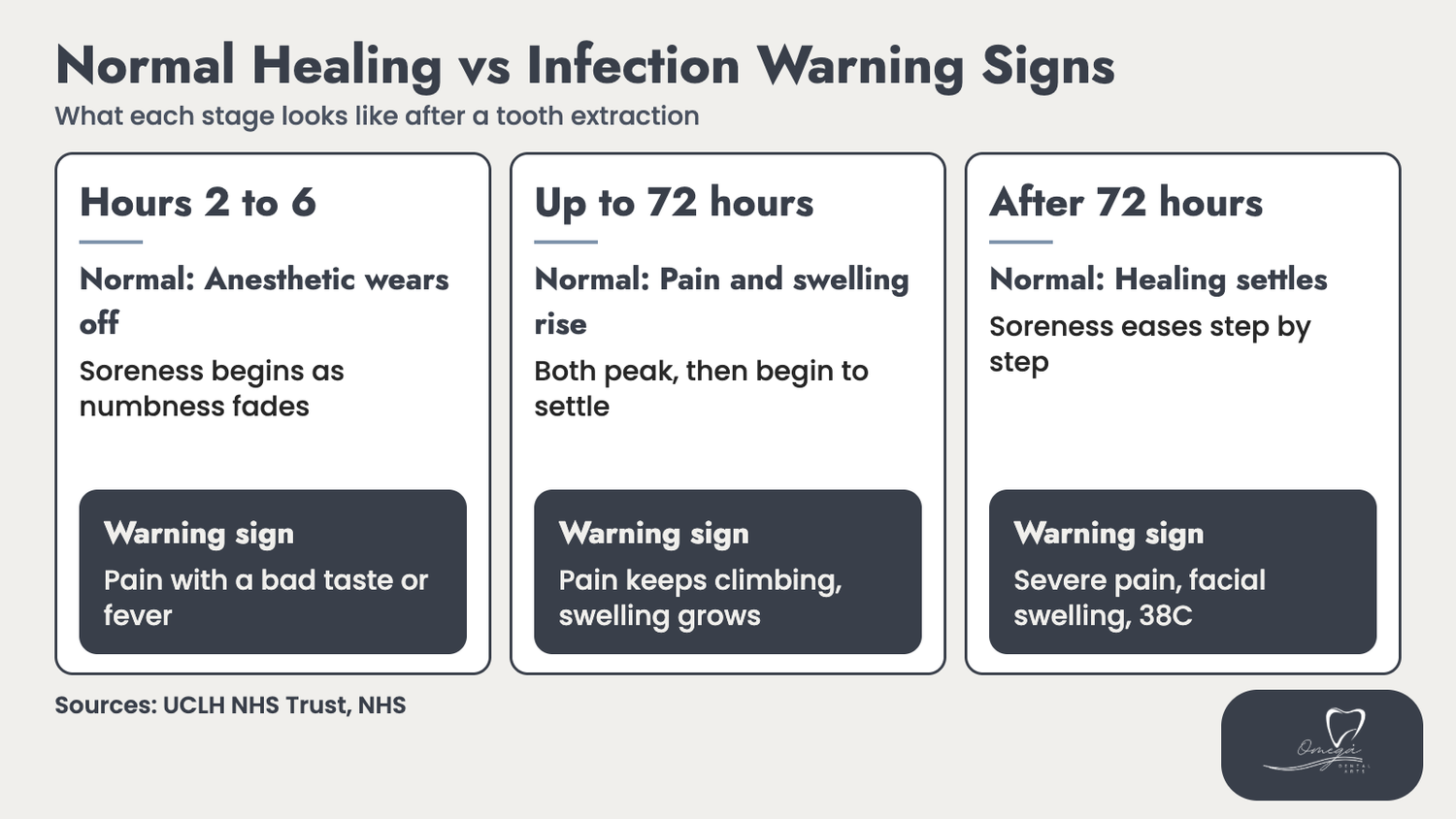
How Do You Tell Normal Healing From Infection?
Normal healing means pain and swelling that rise for 72 hours and then settle. The NHS says soreness after wisdom tooth removal should start to improve after 1 or 2 days. Steady improvement is the sign of healthy recovery, while the table below shows what changes when infection is possible.
| Sign | Normal healing | Possible infection |
|---|---|---|
| Pain | Rises for 72 hours, then settles | Severe or worse despite painkillers |
| Swelling | Rises for 72 hours, then settles | Facial swelling after that point |
| Taste | No bad taste listed as normal | Bad taste in the mouth |
| Temperature | Below 38C (100.4 F) | 38C (100.4 F) or above |
| Bleeding | Blood tinges saliva for a few days | Bleeding that continues after 1 hour of firm biting |
The UCLH NHS Trust and the NHS provide these markers, and a dentist confirms the cause after an exam. Dry socket needs separate attention.
How to Tell the Difference Between Dry Socket and Infection?
Dry socket differs from infection because dry socket is a lost blood clot. Infection is a bacterial problem that may need antibiotics. The NHS describes dry socket as a painful condition where the clot does not form properly or is dislodged. Cochrane (2022) reports dry socket in 1% to 5% of routine extractions. Learn the dry socket symptoms to compare. Both cause pain at the socket, so a dentist makes the diagnosis.
What Are Bad Signs After Getting a Tooth Pulled?
Bad signs after getting a tooth pulled are worsening pain, growing swelling, bleeding that will not stop and a high temperature. The NHS says to seek an urgent dentist appointment for pain and swelling that painkillers do not ease. The UCLH NHS Trust says bleeding after 1 hour of firm biting also needs a call to the dental team.
What Causes Infection After Tooth Extraction?
Bacteria cause infection after tooth extraction, and the NHS notes that smoking can increase the risk of infection. MedlinePlus explains that an abscess is a pocket of pus caused by a bacterial infection. The following factors appear in the NHS and UCLH guidance.
- Smoking, which the NHS says can increase the risk of infection
- A disturbed blood clot, since the UCLH NHS Trust says rinsing, spitting or touching in the first 24 hours can stop healing
- An existing gum infection such as pericoronitis, listed by the NHS
- Surgical removal of impacted wisdom teeth, the group studied in 21 of 23 Cochrane trials
These factors explain why the dentist gives strict aftercare rules. Some infections turn serious, which the next section covers.
What Are the Signs of Serious Infection After Tooth Extraction?
Serious infection after tooth extraction shows as trouble breathing, speaking or swallowing, large swelling in the mouth or difficulty opening the mouth. The NHS lists these as emergency signs, along with a swollen or painful eye. In the United States, these signs call for 911 or an emergency room visit right away. Patients with milder warning signs can reach us for urgent infection care.
What Are the Signs of Sepsis After Tooth Removal?
Signs of sepsis after tooth removal include confusion, uncontrollable shivering, muscle pain, difficulty breathing and blotchy skin. The NHS lists these for adults, along with a high or low temperature. The WHO adds a fast heart rate and rapid breathing. Sepsis is a medical emergency, according to the WHO.
What Does Dental Sepsis Feel Like?
Dental sepsis feels like a sudden shift from local mouth pain to whole-body illness. MedlinePlus lists rapid breathing, fast heart rate, confusion, shivering and clammy skin. MedlinePlus also says early sepsis is hard to diagnose because other conditions cause the same signs.
How Fast Can You Go Septic From a Tooth Infection?
Sepsis from a tooth infection can develop quickly once infection spreads beyond the mouth. StatPearls (2025) calls Ludwig angina rare and life-threatening and says infection can spread rapidly to the floor of the mouth and neck. The same source warns of airway obstruction in severe cases. True Ludwig angina starts from a lower molar infection.
What Are the Signs of Bone Infection After Tooth Extraction?
Bone infection after tooth extraction symptoms include increasing pain, limited mouth opening and an abscess near the jaw. A 2025 Cureus report calls condylar osteomyelitis after a third molar extraction exceptionally rare. MedlinePlus says infection from a tooth can spread to the jaw bone.
What Are the Signs of Sinus Infection After Tooth Extraction?
Signs of sinus infection after tooth extraction include pressure-like facial pain, headache, nasal stuffiness, discharge and fever. MedlinePlus lists these as sinusitis symptoms. A 2006 study of 40 patients linked upper tooth extraction to 65% of odontogenic sinusitis cases. The first upper molar caused 40%.
What Are the Symptoms of Jaw Infection After Tooth Extraction?
Symptoms of jaw infection after tooth extraction are a swollen jaw, intense pain, trouble opening the mouth and swollen neck glands. The NHS lists these for a dental abscess. Difficulty opening the mouth is also an emergency sign when severe. Patients can review extraction jaw pain for the normal pattern.
What Will a Dentist Do for an Infected Extraction Site?
A dentist treats an infected extraction site by examining the area, draining pus and prescribing antibiotics when needed. The NHS says dentists drain the pus and may give antibiotics. A tooth cause may call for root canal treatment or removal. Our extraction treatment visits include this exam.
Bone infection after tooth extraction treatment in the 2025 Cureus report combined drainage with 12 days of intravenous antibiotics. Four weeks of oral antibiotics followed. A patient who suspects infection can follow these steps.
- Check the temperature and note every symptom.
- Call the dental office the same day and describe the signs.
- Keep rinsing gently with warm salt water after the first 24 hours, as the dentist directs.
- Take painkillers at the label dose and avoid aspirin, which the UCLH NHS Trust says may cause bleeding.
- Go to an emergency room for trouble breathing, speaking or swallowing.
Do You Need Antibiotics After Tooth Extraction?
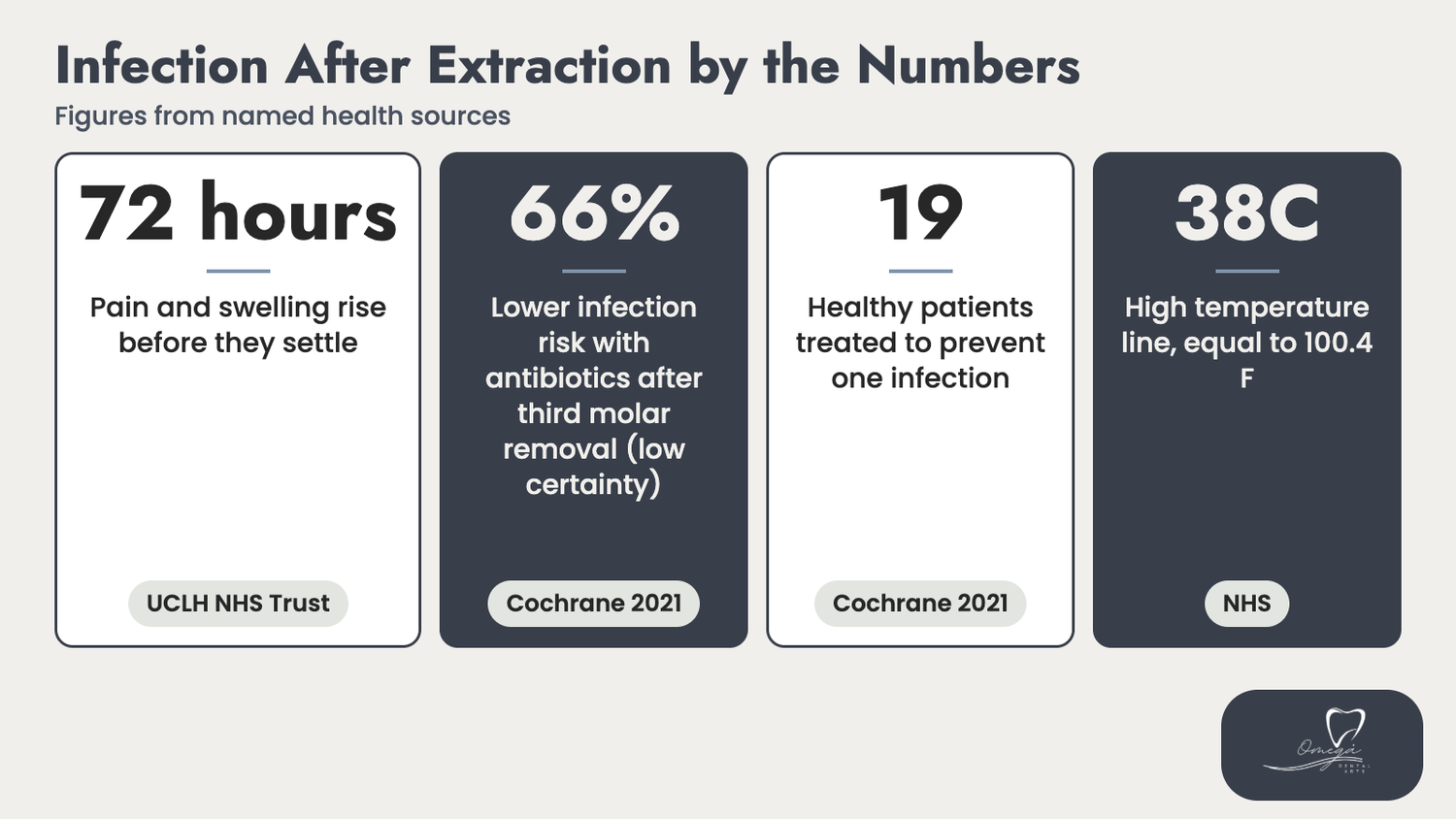
Antibiotics after tooth extraction depend on the patient, and Cochrane tells clinicians to decide case by case. A 2021 Cochrane review found antibiotics may cut infection after third molar extraction by about 66%. About 19 healthy patients need treatment to prevent one infection. The evidence is low certainty, and 21 of 23 trials studied healthy patients.
The cards below summarize the key figures from the UCLH NHS Trust, the NHS and Cochrane.
Can Your Body Fight Off a Tooth Infection by Itself?
A tooth infection will not go away on its own, according to the NHS. The NHS says a dental abscess needs urgent treatment by a dentist. MedlinePlus adds that a toothache may stop when pressure eases, yet the infection stays active and keeps spreading.
Does Salt Water Draw Out an Infection in a Tooth?
Salt water does not treat an infection in a tooth, although warm rinses may ease pain, according to MedlinePlus. The UCLH NHS Trust says to start rinsing 24 hours after extraction. Dissolve two teaspoons of salt in a large cup of hot water. Let it cool and rinse at least 4 times a day.
How to Prevent Infection After Tooth Extraction?
Prevent infection after tooth extraction by protecting the blood clot and following the aftercare rules. The UCLH NHS Trust and the NHS provide the steps below. Leaving the clot alone is the first rule.
- Do not rinse, spit or touch the socket for 24 hours.
- Start warm salt rinses after 24 hours, at least 4 times a day.
- Avoid smoking for at least 48 hours.
- Skip strenuous exercise for 24 hours.
- Finish any prescribed antibiotics as directed.
The UCLH NHS Trust gives the smoking window, and the smoking restrictions post explains it further.
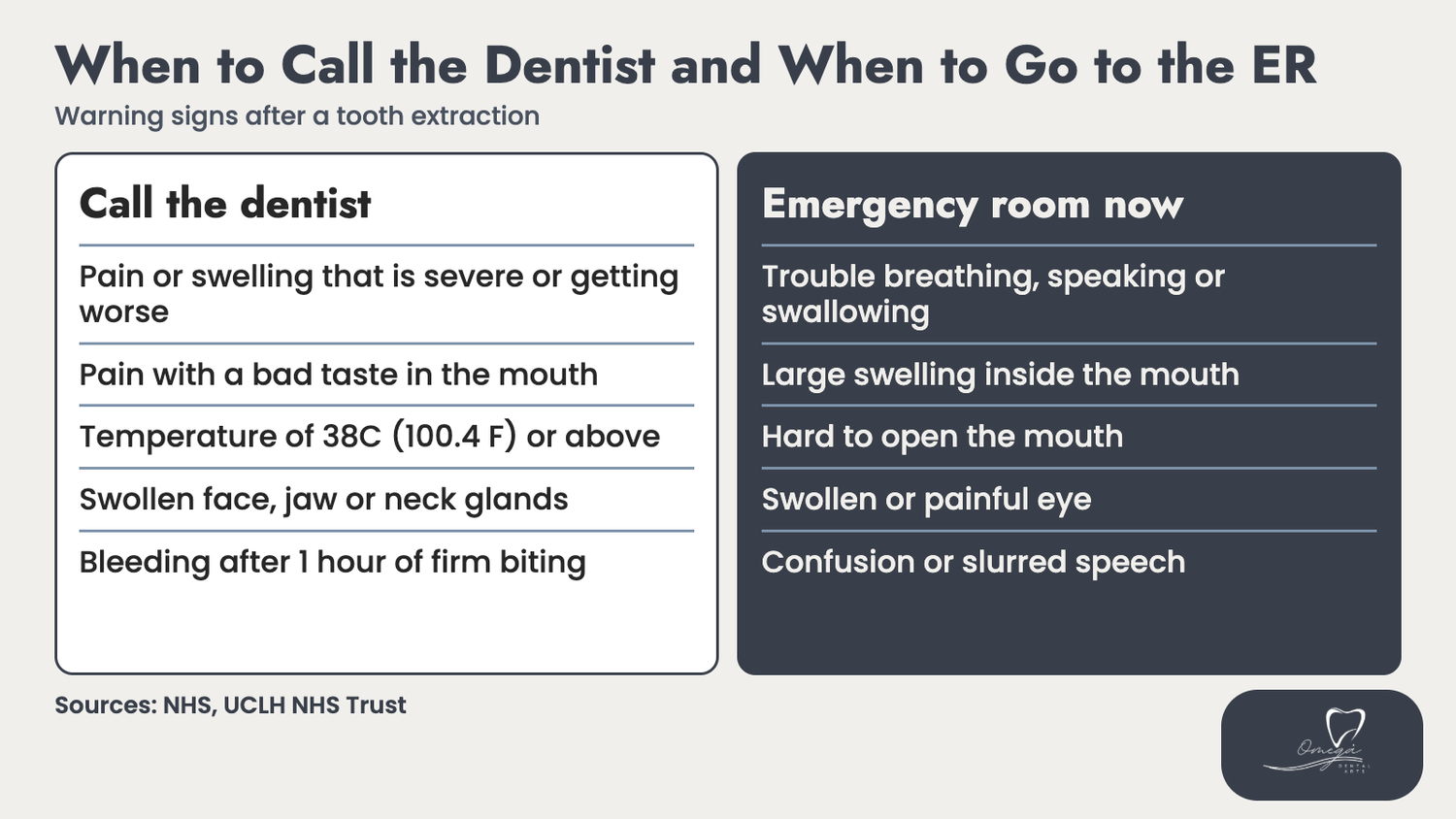
The graphic above separates dentist-call signs from emergency signs.
What Else Should You Know About Infection After Tooth Extraction?
How Long Should You Be Careful After a Tooth Extraction?
Be careful for at least the first 72 hours after a tooth extraction. The UCLH NHS Trust says pain and swelling rise for 72 hours and may last a couple of weeks. Severe pain or facial swelling outside that pattern needs a call to the dental team.
What Is the Worst Day After a Tooth Extraction?
The worst day after a tooth extraction is usually day three. The UCLH NHS Trust says pain and swelling increase for 72 hours and then settle. Pain that stays at its peak or climbs after day three needs a dentist.
What Is the Worst That Can Happen After a Tooth Extraction?
The worst that can happen after a tooth extraction is a spreading infection such as Ludwig angina or sepsis. StatPearls calls Ludwig angina rare and life-threatening. Early care limits that risk, and our post on a abscess warning signs explains how infection builds.
How Fast Does an Infection Go Away After Tooth Extraction?
An infection after tooth extraction goes away at a speed that depends on treatment, with no fixed number of days. The NHS says painkillers may be offered for a few days after abscess treatment. The 2025 Cureus case needed 12 days of intravenous antibiotics before four more weeks of oral antibiotics.
Can You Have a Tooth Extracted If It Is Infected?
Yes, a dentist can remove an infected tooth. The NHS lists tooth removal beside root canal treatment as a way to treat an abscess. The dentist uses local anesthetic so the patient feels no pain, according to the NHS.
Frequently Asked Questions
What Are Four Early Signs of Sepsis?
Four common signs of sepsis in adults are confusion, uncontrollable shivering, muscle pain and difficulty breathing, according to the NHS. The NHS also lists blotchy skin and a high or low temperature. Sepsis needs immediate medical help.
How Do You Know If a Tooth Infection Is in Your Bloodstream?
A doctor confirms a bloodstream infection with a history, a physical exam and vital signs, according to MedlinePlus. Vital signs are temperature, blood pressure, heart rate and breathing. Whole-body signs such as confusion or shivering call for emergency care.
What Kills Tooth Infection Bacteria?
Dental treatment and antibiotics address tooth infection bacteria, according to the NHS and MedlinePlus. The dentist drains pus, may perform a root canal or removal and may prescribe antibiotics. Dentist treatment is the step that removes the source.
How Does Omega Dental Arts Help With Infection After Tooth Extraction?
We help with infection after tooth extraction by examining the site, finding the cause and treating it. Our doctors review pain, swelling, temperature and healing at each visit. Patients can request an appointment when warning signs appear.
Our team in Cherry Hill sees patients from across Camden County with swelling, pain or a bad taste after an extraction. We explain each step and answer questions before treatment begins.
Patients can meet the doctors at Omega Dentists.