Partial dentures before and after results show missing teeth replaced, and a 2025 meta-analysis found 95.1% five-year survival for cast-clasp partials. The NHS says getting used to dentures takes a few weeks. The ADA says a new partial may feel awkward or bulky at first, and speech settles with practice. The result depends on which teeth are missing and how healthy the remaining teeth are.
Key Takeaways
- MedlinePlus says partial dentures replace one or a few missing teeth.
- The ADA reports that a new partial may feel awkward or bulky at first.
- The NHS states that getting used to dentures takes a few weeks.
- A 2025 Journal of Prosthetic Dentistry review found a 95.1% five-year survival rate for cast-clasp partials.
- A five-year study of 88 patients linked visible clasps to lower esthetic scores than attachment-retained designs.
What Do Partial Dentures Before and After Results Look Like?
Partial dentures before and after results show gaps from missing teeth filled by replacement teeth on a gum-colored base. According to MedlinePlus, partials replace one or a few teeth. The visible change is a complete-looking smile that the wearer removes for cleaning.
The ADA describes a removable partial denture as replacement teeth attached to a pink or gum-colored plastic base. The base may sit on a metal framework with clasps that grip natural teeth. Other designs use connectors that look more natural.
NIDCR reports that adults 20 to 64 average 26 remaining teeth, down from a full set of 32. Our team plans denture treatment around the teeth that remain.
How Does a Partial Denture Change Your Smile, Bite and Speech?
A partial denture changes your smile, bite and speech by replacing the missing teeth that shaped each one. The ADA says eating should become more pleasant with dentures, and speech can improve. Adjustment takes practice before the change feels normal.
The table below compares the mouth before a partial denture with the mouth after the adjustment period, using ADA and NHS descriptions.
| Area | Before | After adjustment |
|---|---|---|
| Smile | Visible gaps where teeth are missing | Replacement teeth on a gum-colored base fill the gaps |
| Eating | Fewer teeth to chew with | The ADA says eating should become more pleasant |
| Speech | Gaps can change how words sound | The ADA says practice builds clear speech |
| Daily routine | Brushing natural teeth only | Removing and cleaning the denture each day |
Speech deserves a closer look because the tongue needs time to learn the new shape. A Brazilian Dental Journal study of 15 patients found articulation problems were generally resolved after one week of use.
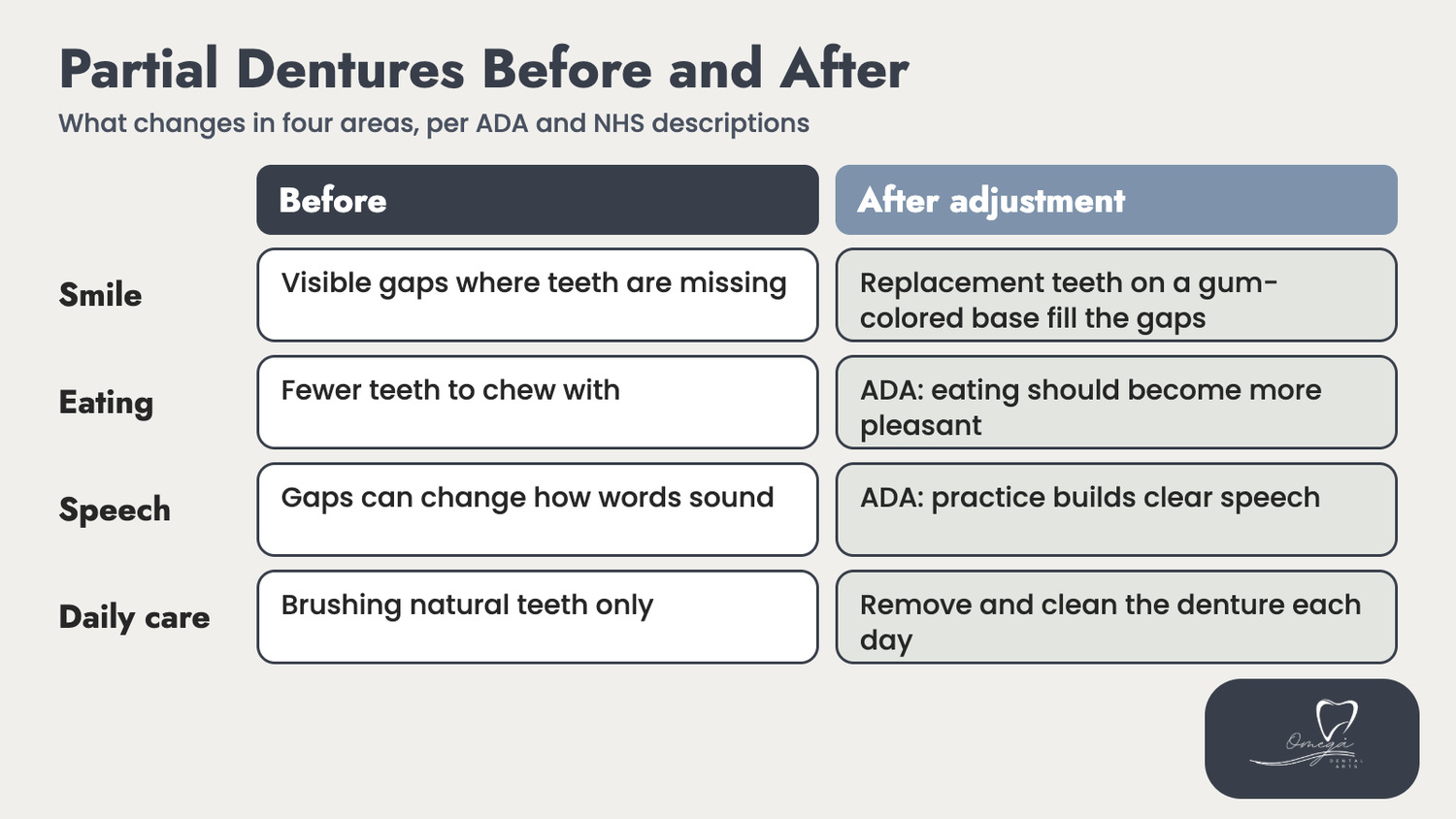
The graphic above shows these four changes side by side. The next section applies the same comparison to front teeth, where appearance matters most.
Can You Get a Partial Denture for Front Teeth?
Yes, you can get a partial denture for front teeth, since the NHS says partials replace one or more missing teeth. The ADA notes that precision attachments are generally more esthetic than clasps. Attachments are generally more esthetic than clasps.
A partial dentures front teeth before and after comparison shows the gap and then the replacement teeth in the same position. Clasps or attachments hold the denture to natural teeth nearby.
How Do Metal Clasps Show on Front Teeth?
Metal clasps show on front teeth when they sit on teeth that are visible during a smile. A five-year study of 88 patients found clasp-retained maxillary partials scored lower on esthetic satisfaction than attachment-retained or implant-retained designs. Attachment designs hide more metal.
The same study notes that its results may reflect patient self-selection rather than denture design alone. The ADA adds that crowns on natural teeth are sometimes needed to improve fit, and they are usually required with attachments.
What Do Before and After Upper Partial Dentures Show?
Before and after upper partial dentures show missing upper teeth replaced by artificial teeth on a gum-colored base. The ADA notes a partial may feel bulky at first. Upper partials restore the visible smile line once the wearer adjusts.
Speech may feel different at first. The ADA suggests reading aloud and repeating the words that cause trouble. With time, the wearer becomes accustomed to speaking properly.
What Happens at Each Step From Impressions to Final Fit?
The steps from impressions to final fit begin with an assessment, and the NHS says dentures take a few weeks to make. The dentist then measures your mouth and makes a mould or scan. Fitting happens at a second appointment.
- The dentist assesses your teeth and decides whether dentures suit you, as the NHS describes.
- The dentist measures your mouth and makes a putty mould or a scan, according to the NHS.
- The laboratory makes the denture, which takes a few weeks.
- You return for a second appointment to have the denture fitted.
- The dentist adjusts any spot that presses too hard, as the ADA describes.
Some patients receive immediate dentures. The NHS says these often need adjusting or replacing up to a year later. The mouth changes shape as it heals after teeth are removed.
How Long Does It Take for Your Mouth to Get Used to Partial Dentures?
It takes a few weeks for your mouth to get used to partial dentures, according to the NHS. The ADA says the denture may feel awkward or bulky at first. Comfort builds as the mouth adapts.
The table below places each source finding on a timeline from the fitting day to the first year.
| Period | What the source reports | Source |
|---|---|---|
| Fitting day | The denture may feel awkward or bulky | ADA |
| First week | Articulation problems generally resolved in 15 patients | Brazilian Dental Journal |
| A few weeks | Getting used to wearing dentures | NHS |
| Up to a year | Immediate dentures often need adjusting or replacing | NHS |
The ADA recommends soft foods cut into small pieces at the start. Chew on both sides of the mouth to keep pressure even. Avoid extremely sticky or hard foods and chewing gum during the adjustment period.
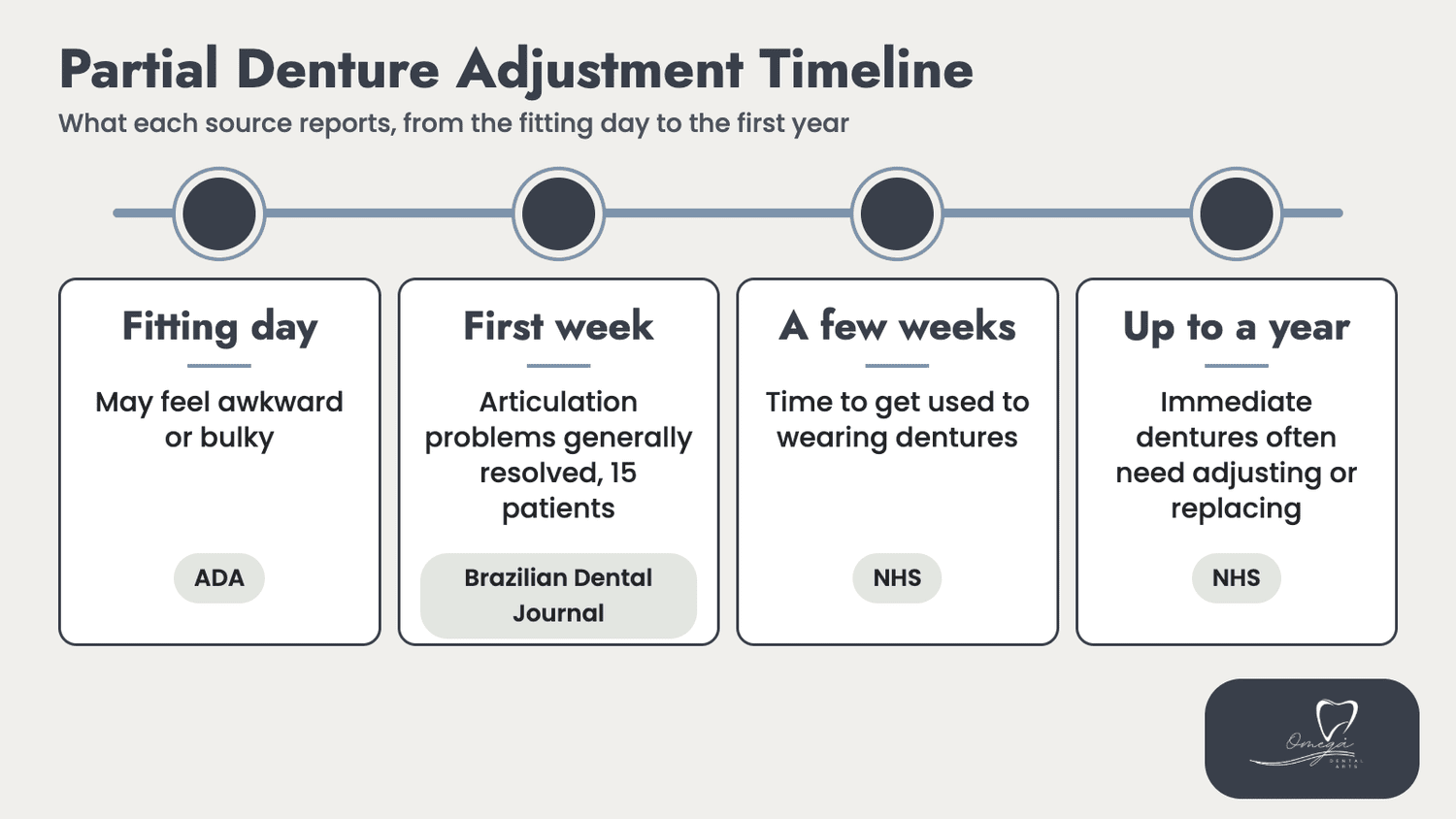
The timeline above summarizes the periods in the table. Sore spots during these weeks need a closer look.
How Do You Know When a Sore Spot Needs an Adjustment?
A sore spot needs an adjustment when the denture presses too hard on one area. The ADA says that spot will become sore and the dentist will adjust the denture. Pressure on one spot signals a fit problem.
The ADA states that the dentist may ask you to wear the partial all the time at first. Constant wear is the quickest way to identify areas that need adjustment. After adjustments, the dentist will probably recommend removing it before bed.
- A spot that stays sore after a day of wear
- A denture that feels loose, which the ADA says needs prompt attention
- A cracked, chipped or broken denture, or a loose tooth on the denture
- Very red or bleeding gums or bad breath, which the NHS links to gum disease, infection or decay
Call your dentist about any item on this list. The next section covers daily habits that protect the denture and your natural teeth.
How Do You Care for a Partial Denture?
You care for a partial denture by brushing it daily, rinsing it after meals and soaking it overnight. The ADA says to brush the denture each day to remove food deposits and plaque. Daily brushing prevents permanent staining.
MedlinePlus advises taking dentures out at night and placing them in water or a denture-cleansing liquid. The ADA adds that a denture can lose its shape if it dries out. Look for cleansers with the ADA Seal of Acceptance. Our denture care team can recommend a cleaner.
- Use a denture brush or a soft-bristled toothbrush, not hard bristles.
- Skip toothpaste, which the ADA calls too harsh for dentures.
- Stand over a folded towel or a sink of water while cleaning.
- Rinse the denture thoroughly before placing it in your mouth.
- Brush your gums, tongue and remaining teeth with fluoride toothpaste, as the NHS advises.
Good care also protects the denture over time, which raises the question of how long a partial lasts.
How Long Do Partial Dentures Last?
Partial dentures survived five years at rates above 91% in a 2025 meta-analysis of 46 studies. The review reported 95.1% five-year survival for cast-clasp partials and 91.7% for partials retained by telescopic crowns. Five-year survival exceeded 91% in both designs.
The review covered 4,072 participants with a mean age of 60. The review also found that abutment teeth and nonvital teeth had a higher risk of extraction after five years. Regular dental visits help catch these changes early.
A separate review of 35 studies reported patient satisfaction with removable partial dentures ranging from 50% to 81%. Satisfaction varied with age, denture experience and design. Fit also changes over time, which the next section explains.
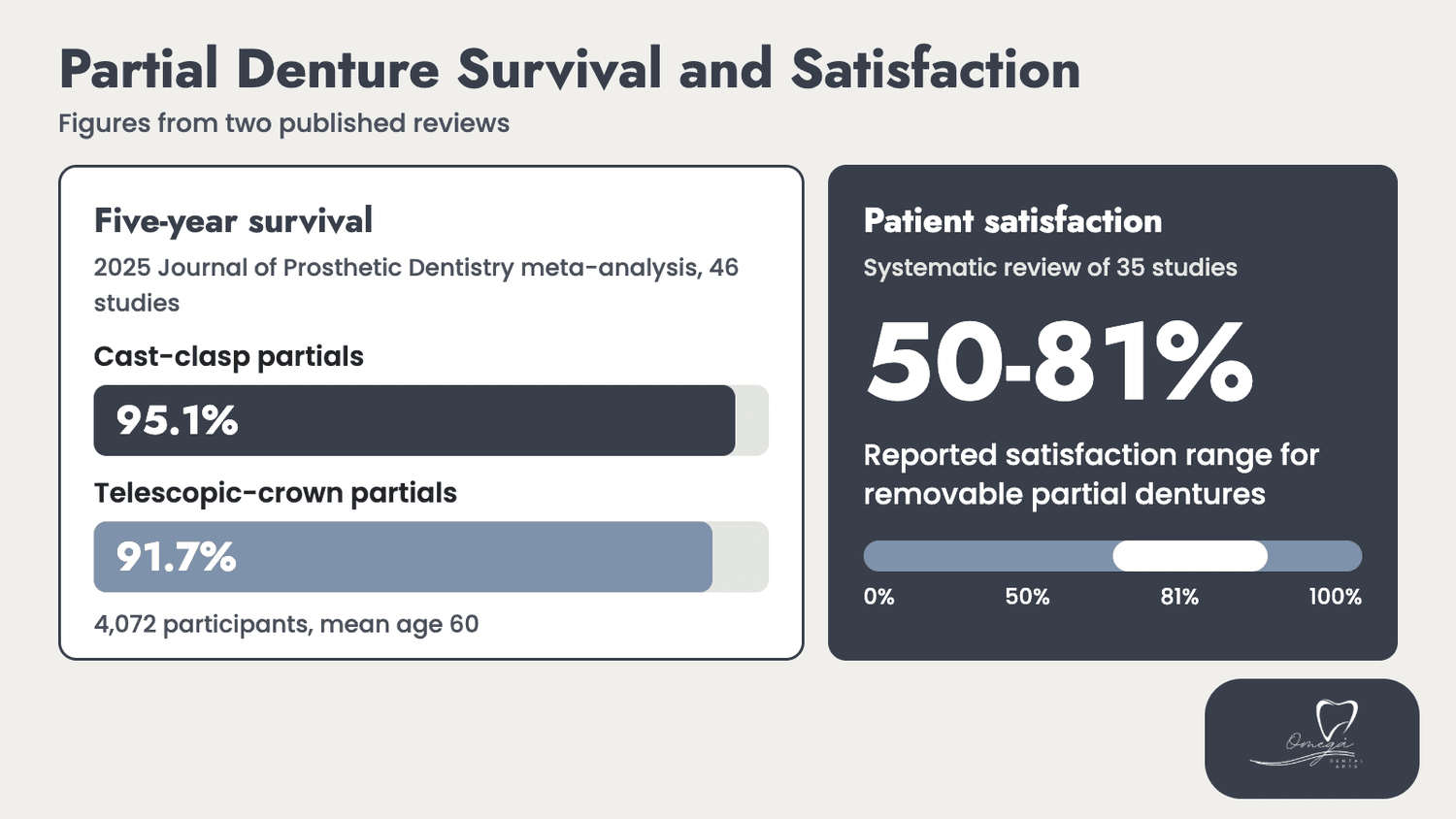
The chart above shows the survival and satisfaction figures from these two reviews.
How Does a Partial Denture Compare With a Bridge or Implant?
A partial denture compares with a bridge or implant mainly by whether it comes out of the mouth. The NHS says bridges are fixed to other teeth and cannot be removed. A partial denture is the removable option.
The table below lists how each option attaches, using NHS and ADA descriptions.
| Option | Removable | How it attaches |
|---|---|---|
| Partial denture | Yes | Clasps or attachments on natural teeth |
| Dental bridge | No | Fixed to other teeth |
| Dental implant | No | Fixed to the jawbone |
MedlinePlus notes that implants are permanent and replace both the roots and the teeth. Fixed options also change how results look, and the bridge article on bridge results shows that side. Both fixed options need healthy neighboring teeth or enough jawbone, so the dentist checks these first.
An implant adds an artificial root under the replacement tooth, and MedlinePlus describes it as a permanent option. A removable partial asks for daily cleaning and nightly removal instead. Compare implant treatment with a removable partial before you decide on the approach that suits your mouth.
A longer comparison of implants vs dentures covers stability, care and what each option replaces.
What Else Should You Know About Partial Dentures?
What Can You Not Eat With Partial Dentures?
You should not eat extremely sticky or hard foods with partial dentures, according to the ADA. The ADA also suggests skipping chewing gum during the adjustment period. Start with soft foods cut into small pieces.
Chewing on both sides of the mouth keeps pressure even. The ADA says this also helps the denture settle comfortably.
How Many Hours a Day Should You Wear a Partial Denture?
You should wear a partial denture for the hours your dentist specifies, and the ADA says the dentist gives specific instructions. Early wear may be all day so sore spots show up quickly.
After adjustments, the ADA says the dentist will probably recommend removing it before bed. Replace it in the morning.
Why Can't You Sleep With Partial Dentures?
You cannot sleep with partial dentures unless your dentist says so, because the NHS links overnight wear to trapped food. The ADA says dentists may ask for all-day wear at first. Removal at night is the standard advice once adjustments are done.
The NHS advises against wearing dentures overnight unless your dentist recommends it. Trapped food raises the risk of gum infections and tooth decay. Sleeping with the denture in also carries a choking risk, according to the NHS.
Will Your Partial Denture Need Changes Over Time?
Your partial denture will need changes over time because the mouth changes with age. The ADA says bone and gum ridges can recede or shrink, which leaves a poorly fitting denture. Loose dentures need a dentist, not a home fix.
MedlinePlus agrees that dentures may need to be adjusted or replaced as the mouth changes. MedlinePlus also says to let your dentist handle those adjustments. Keep your regular visits, such as regular checkups, so the fit gets reviewed.
Can You Fix a Broken Partial Denture at Home?
You cannot safely fix a broken partial denture at home. The ADA warns that do-it-yourself kits can damage the appliance beyond repair. Over-the-counter glues often contain harmful chemicals, according to the ADA.
Call your dentist right away when a denture breaks, cracks or chips. The ADA says dentists can often make repairs on the same day. Complicated repairs may go to a dental laboratory. A cracked denture that cannot wait may count as emergency dental care.
How Does a Partial Denture Affect Your Remaining Teeth?
A partial denture affects remaining teeth mainly through the teeth that hold its clasps. The 2025 meta-analysis found tooth mobility and probing depth stayed unchanged, while the gingival index increased. The review found few periodontal changes.
The authors state that a high survival rate came with few periodontal changes to the remaining teeth. Daily cleaning of the denture and the natural teeth keeps plaque from building up around the clasps.
Can You Tell If Someone Has Partial Dentures?
You can tell if someone has partial dentures mainly where clasps touch visible teeth. The ADA says attachments generally look more natural than clasps. Design choice controls visibility, so ask your dentist about attachment options for front teeth.
The five-year study of 88 patients measured esthetic satisfaction directly. Clasp-retained designs scored lowest in that comparison. Replacement teeth are matched to the shape and color of the surrounding teeth.
How Does Omega Dental Arts Help With Partial Dentures?
Omega Dental Arts helps with partial dentures by examining your teeth, planning the design and fitting the denture with you. We are located in Cherry Hill, and our doctors review the fit at follow-up visits. Every fitting includes a bite check.
Our team explains the options and how each one looks in your mouth. We share the ADA and NHS care steps so you know what to expect. Review our denture options before your visit.
Molar gaps follow the same process with a different design focus, since chewing surfaces matter most there. Partial dentures for the back of the mouth are covered in the article on back teeth partials, which explains how they work.
Our doctors review the fit at follow-up visits, and the team answers questions about care, cleaning and adjustments at each one. Talk with us about your missing teeth at Omega Dental Arts, and bring your questions.