A toothache is caused by irritation, inflammation or infection inside or around a tooth, and MedlinePlus says cavities are a common source. Cracks, damaged fillings, gum disease and grinding can also trigger pain. The CDC reports that 1 in 5 adults aged 20 to 64 has at least one untreated cavity. Pain lasting longer than a day or two needs a dentist.
Key Takeaways
- Tooth decay is a leading source of toothache. The CDC reports 1 in 5 adults aged 20 to 64 has an untreated cavity.
- Cracked teeth, worn fillings, gum disease and grinding are the other common dental causes.
- Sinus infections, jaw joint problems, wisdom teeth and even heart attacks can feel like tooth pain.
- Throbbing pain with fever or facial swelling points to infection and needs prompt care.
- Home measures only ease symptoms for a short time, so a dentist must treat the cause.
- Brushing twice a day with fluoride toothpaste and regular dental visits lower the risk of future pain.
What Causes a Toothache?
What causes a toothache is inflammation of the dental pulp, the soft center of the tooth that holds nerves and blood vessels. Decay, cracks, injury and infection can all reach the pulp. According to MedlinePlus, a toothache is often the result of cavities, infection or irritation of the tooth.
Tooth pain can feel dull, sharp or throbbing depending on the cause. Cleveland Clinic lists a dull ache, sharp jabbing pain, throbbing pain and sensitivity to hot or cold as common patterns. Our emergency dentist team sees each of these patterns, and each points toward a different cause.
Why Do I Have a Toothache From Tooth Decay?
You have a toothache from tooth decay when acid-producing bacteria dissolve enamel and the cavity reaches the sensitive layers below. According to the NIDCR, advanced decay can cause a toothache or sensitivity to sweets, hot or cold. Early decay usually causes no pain, so a cavity can grow unnoticed.
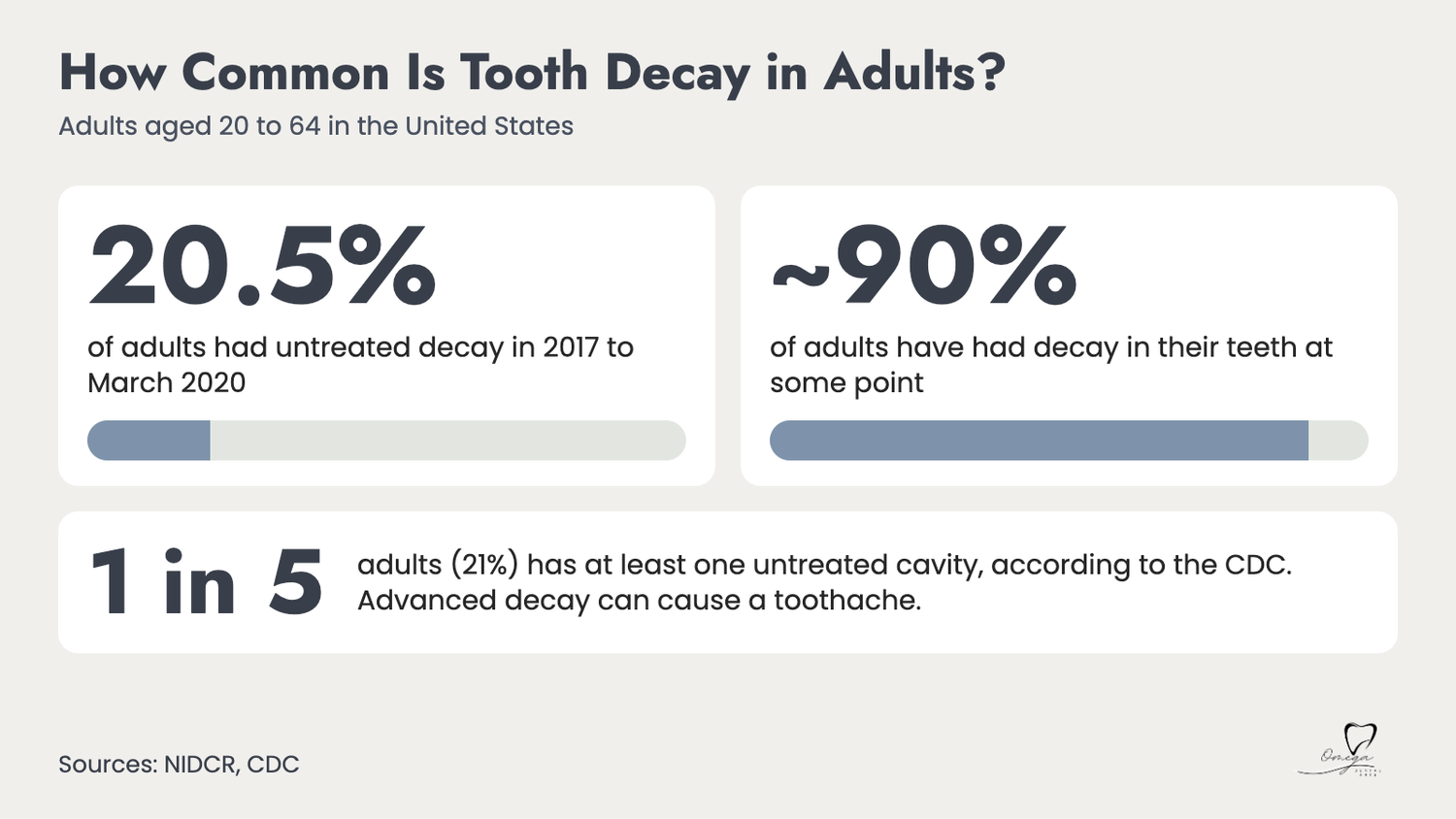
The scale of the problem explains why decay tops most cause lists. The NIDCR found that 20.5% of adults aged 20 to 64 had untreated decay in 2017 to March 2020. Nearly 90% have had decay at some point. The graphic below shows these figures.
Can a Cracked Tooth or Damaged Filling Cause a Toothache?
A cracked tooth or damaged filling can cause a toothache because the crack or gap exposes the inner tooth to bacteria. According to the American Association of Endodontists (AAE), a cracked tooth causes erratic pain when chewing, sometimes when you release the bite.
The AAE also says craze lines, which are tiny cracks in the outer enamel, cause no pain. Cleveland Clinic lists a damaged filling or crown among the common reasons for tooth pain. A dentist can often repair the tooth with a filling or a dental crown, depending on the damage.
Does Gum Disease Cause Tooth Pain?
Gum disease does cause tooth pain in some people, because infected gums can swell, recede and expose sensitive root surfaces. Cleveland Clinic lists gum disease among the causes of a toothache. The NIDCR describes gum disease as an infection of the tissues that hold teeth in place.
Plaque and tartar drive that infection. Regular professional cleanings remove tartar that brushing cannot reach.
What Causes a Throbbing Toothache?
What causes a throbbing toothache is most often an infected pulp or an abscess, a pocket of pus at the root tip. According to MedlinePlus, a tooth abscess brings a severe, continuous toothache that can feel gnawing, sharp, shooting or throbbing.
MedlinePlus adds that the pain may ease if pressure releases, yet the infection stays active and keeps spreading. Fever, bad breath, pain when chewing and gum swelling that looks like a pimple often come with it. Our post on a dental abscess covers these signs in detail.
What Causes Toothache Pain That Is Not From the Tooth?
What causes toothache pain outside the tooth is referred pain, where a nearby structure sends signals read as tooth pain. MedlinePlus notes that pain felt in a tooth can come from other body parts, and an earache is one example.
The table below compares the common lookalikes with their dental counterparts and shows who evaluates each one.
| Source of pain | How it can feel | Who evaluates it |
|---|---|---|
| Sinus infection | Pressure-like pain, upper tooth ache, facial tenderness | Primary care provider |
| Jaw joint disorder | Jaw or muscle pain that spreads to the face or neck | Dentist or physician |
| Earache | Pain felt in a tooth | Primary care provider |
| Heart attack | Jaw, neck or tooth pain with other warning signs | Emergency services |
| Abscess or decay | Pain in one tooth, often worse with hot, cold or biting | Dentist |
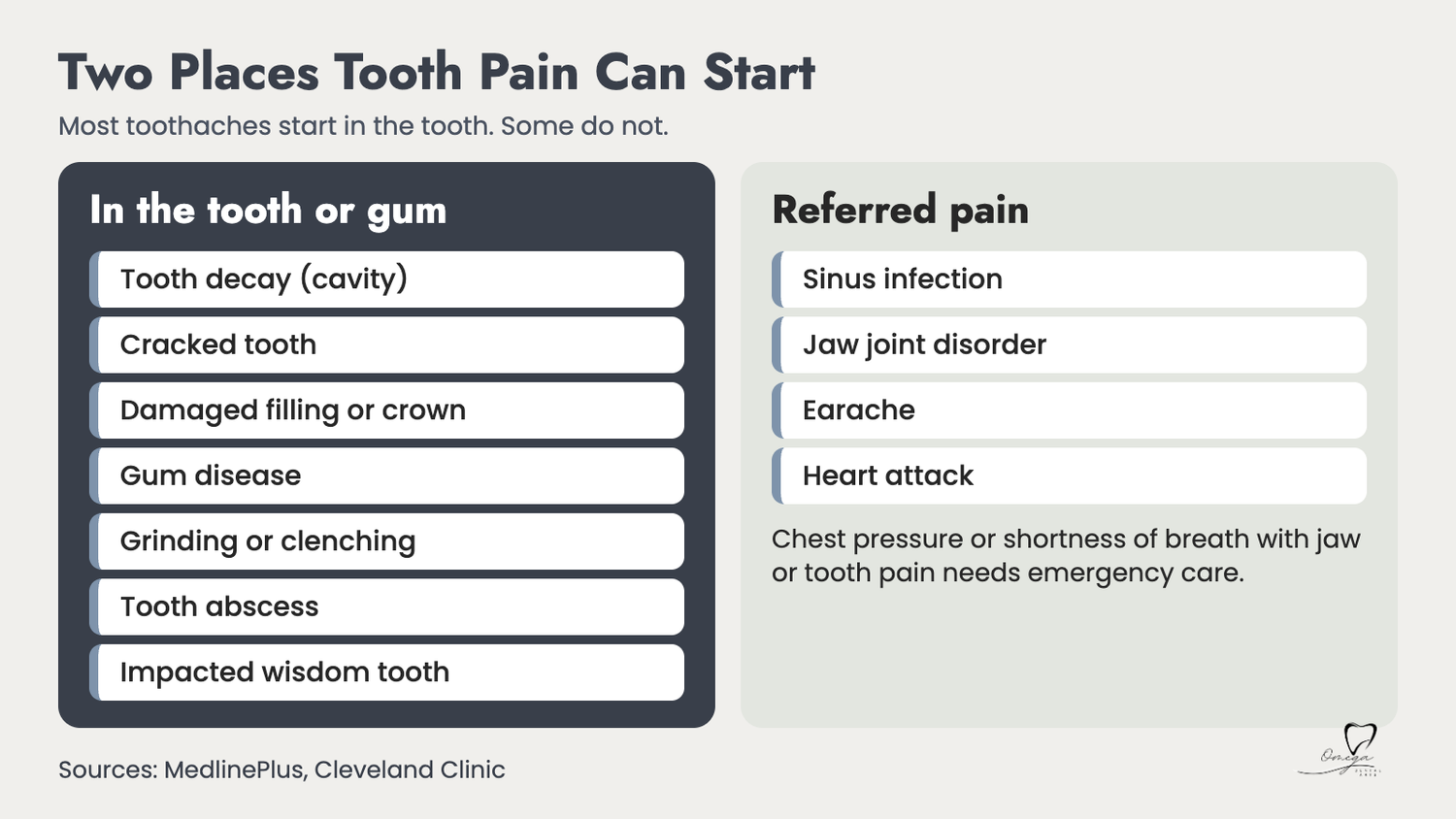
MedlinePlus states that a dentist is the right person for most toothaches. Referred pain may need a primary care provider. The graphic below maps these causes.
What Is Mistaken for a Toothache?
A sinus infection, a jaw joint disorder, an earache and a heart attack are what is mistaken for a toothache. MedlinePlus lists toothache as a sinusitis symptom, and it lists jaw pain or toothache as part of a heart attack.
What Causes Toothache During Pregnancy?
What causes toothache during pregnancy is mostly the same set of dental problems, with gum inflammation added by hormone changes. According to the CDC, pregnant women are more likely to develop gingivitis, and changing hormones can worsen it.
Why Do You Get a Toothache From Grinding Your Teeth?
You get a toothache from grinding because clenching and grinding stress the teeth, ligaments and jaw muscles. Cleveland Clinic lists bruxism among toothache causes and says a dull, persistent ache can signal grinding during sleep.
The AAE adds that clenching or grinding can contribute to cracked teeth. MedlinePlus advises telling your dentist if you think you grind. The dentist may recommend an appliance that protects the teeth from wear.
Can Wisdom Teeth Cause a Toothache?
Wisdom teeth can cause a toothache when an impacted tooth stays stuck in the gum or bone. The gum around it can become sore and swollen. MedlinePlus says impacted wisdom teeth are common and often painless.
How Can You Tell If Tooth Pain Is an Infection?
You can tell if tooth pain is an infection by watching for continuous severe pain, fever, facial swelling or a gum bump. MedlinePlus lists these as the main signs of a tooth abscess, and only a dentist can confirm the diagnosis.
Cleveland Clinic says unbearable tooth pain with fever and chills is a dental emergency. Call a dentist or go to the nearest emergency room right away in that case.
The steps below show how to sort your symptoms before you call.
- Note whether the pain is constant or comes and goes.
- Check for swelling in the gum, cheek or jaw.
- Take your temperature and write it down.
- Notice any bad taste, bad breath or pain when opening wide.
- Call a dentist the same day if any of these signs appear.
What Does Tooth Sepsis Feel Like?
Tooth sepsis feels like a severe whole-body illness that follows a tooth infection, with fever, confusion, a fast heartbeat and extreme pain. According to the CDC, sepsis happens when an infection you already have triggers a chain reaction throughout your body.
The CDC lists clammy skin, confusion, extreme pain, fever or shivering, a high heart rate and shortness of breath as warning signs. Sepsis is a medical emergency, so seek emergency care at once.
How Long Will a Toothache Last?
A toothache lasts a day or two when the cause is temporary gum irritation. The pain does not fully go away when the cause is a cavity or abscess. Cleveland Clinic states that the duration depends on the underlying cause.
MedlinePlus advises seeking care for a toothache that lasts longer than a day or two. Cleveland Clinic sets the call-a-dentist mark at two days. Pain that fades without treatment still deserves an exam, because an infection can stay active.
What Should You Do When You Have a Toothache?
What you should do when you have a toothache is rinse gently, take a labeled over-the-counter pain reliever and call a dentist. MedlinePlus says you can use over-the-counter pain medicine if you cannot see your dentist right away.
These steps buy time and do not treat the cause. The post on how to stop a toothache adds more first-aid detail.
- Rinse with warm salt water for 30 seconds and spit it out.
- Hold a cold pack wrapped in a towel against the outside of the jaw for about 20 minutes.
- Take an over-the-counter pain reliever exactly as the label directs.
- Keep the area clean and avoid very hot, cold or hard foods.
- Call a dentist the same day to book an exam.
How Do I Get My Toothache to Stop?
You get your toothache to stop by having a dentist treat its cause, such as with a filling, root canal or extraction. According to MedlinePlus, treatment depends on the source of pain and can include removing and filling cavities, root canal therapy or extraction.
Cleveland Clinic states that antibiotics and pain relievers ease symptoms only temporarily, and an infection returns unless the underlying issue is treated. Home steps simply bridge the gap until your visit.
What Gets Rid of Toothache ASAP?
What gets rid of a toothache ASAP is a same-day dental exam. Only a dentist can remove decay, drain an infection or repair a crack. MedlinePlus says your dentist will first diagnose the source of the pain and then recommend treatment.
When you call, describe the location, the trigger and any swelling or fever. The dentist uses these details, plus an exam and X-rays, to find the cause. For urgent cases our toothache emergencies page explains how we help.
What Is the 3-3-3 Rule for Toothaches?
The 3-3-3 rule for toothaches is a popular online pain-medicine schedule that no agency cited here endorses. MedlinePlus and Cleveland Clinic recommend only that you use over-the-counter pain medicine as labeled while you wait to see a dentist.
What's the Strongest Painkiller for Toothache?
The strongest painkiller for toothache is not a pill you choose yourself, because a dentist selects pain medicine after finding the cause. MedlinePlus says your dentist may prescribe antibiotics, pain medicines or other medicines after the exam.
Why Isn't Ibuprofen Helping My Toothache?
Ibuprofen is not helping your toothache most likely because the cause, such as an abscess or deep decay, needs dental treatment. Cleveland Clinic lists unbearable pain that does not improve with medication as a reason to head to the emergency room.
MedlinePlus explains that an abscess keeps spreading and destroys tissue even when the pain eases. Taking more medicine than the label allows is not the answer. Call a dentist or seek emergency care instead.
Does Salt Draw Out an Infection in a Tooth?
Salt does not draw out an infection in a tooth. A salt rinse only cleans the mouth and may calm sore gums. Cleveland Clinic says warm salt water can reduce inflammation and offer toothache pain relief.
Can Hydrogen Peroxide Help With Tooth Pain?
Hydrogen peroxide can help with tooth pain only as a diluted rinse that eases inflammation briefly. Cleveland Clinic says you should never rinse with pure hydrogen peroxide and should mix it with equal parts water.
What Not to Do During a Toothache?
What not to do during a toothache is wait it out, rinse with undiluted peroxide or swallow rinse solutions. MedlinePlus advises seeking care when a toothache lasts longer than a day or two, and Cleveland Clinic warns against pure peroxide.
Can I Get Antibiotics for a Tooth Infection Without Seeing a Dentist?
You cannot reliably get antibiotics for a tooth infection without seeing a dentist, because the source must be found and treated first. MedlinePlus says the dentist diagnoses the cause of pain before recommending treatment, which may include antibiotics.
Cleveland Clinic states that antibiotics alone only give temporary relief. The infection returns unless the tooth itself receives treatment.
What Kills Nerve Pain in a Tooth?
What ends nerve pain in a tooth is dental treatment of the pulp, usually root canal therapy or extraction. MedlinePlus lists root canal therapy and tooth extraction among toothache treatments. Cleveland Clinic describes root canal therapy for an infected pulp.
Over-the-counter medicine only dulls the signal for a few hours. A dentist decides which treatment fits your tooth, and our restorative care covers those options.
What Should I Do If My Tooth Pain Isn't Going Away?
What you should do if your tooth pain is not going away is call a dentist now. MedlinePlus advises care when a toothache lasts longer than a day or two. Persistent pain usually signals a cavity, crack or infection that will not heal alone.
Book an exam, and go to the emergency room if fever, facial swelling or uncontrolled bleeding appear. Our post on waiting too long explains why delay makes problems larger.
When Should You See a Dentist or Go to the ER for a Toothache?
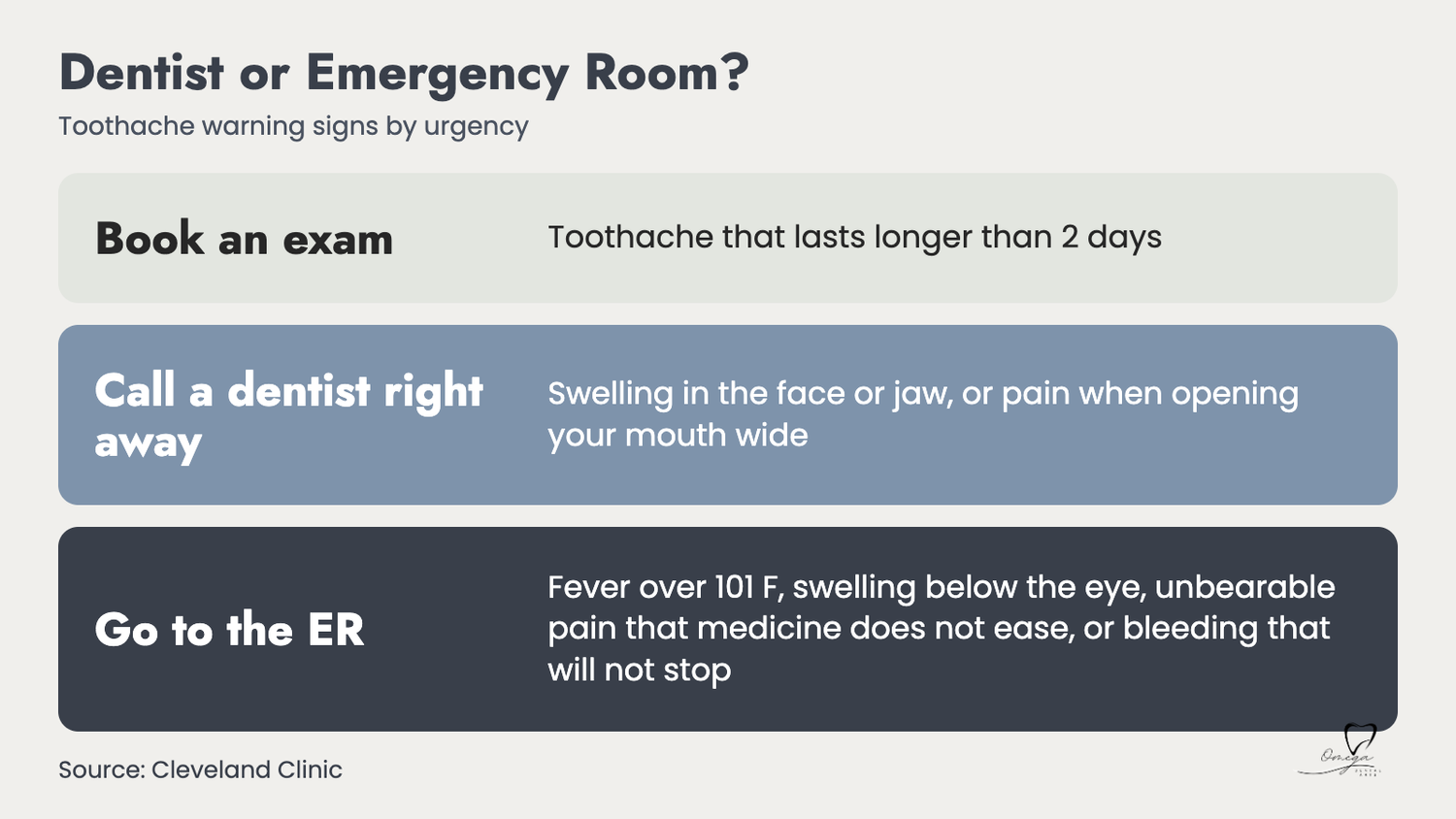
You should see a dentist when a toothache lasts longer than two days. Go to the ER for fever above 101 degrees Fahrenheit. Cleveland Clinic sets both thresholds in its toothache guidance.
Cleveland Clinic also lists swelling in the face or jaw and pain when opening wide as reasons to call right away. Its ER list adds swelling below the eye and a knot on the jaw. The list also includes unbearable pain that medicine does not ease and bleeding that will not stop.
The graphic below summarizes these thresholds in order of urgency.
How Can You Protect Your Teeth From a Toothache?
You can protect your teeth from a toothache by brushing twice a day with fluoride toothpaste. Limiting sugary foods and drinks and keeping regular dental visits also help. The NIDCR recommends the first two, and MedlinePlus adds flossing and professional cleaning.
The habits below lower the chance of decay and gum problems, the two causes covered earlier.
- Brush twice a day with fluoride toothpaste, as the NIDCR advises.
- Floss between teeth once a day, as Cleveland Clinic recommends.
- Limit sugary drinks and foods high in sugars and starches.
- Ask about sealants, which the NIDCR says cover chewing surfaces and help prevent decay.
- Tell the dentist if you think you grind your teeth at night.
- Keep up routine dental visits so small problems are found early.
Cleveland Clinic cautions that not every toothache can be prevented. Early exams still catch many problems before they hurt.
What Else Should You Know About a Toothache?
Does Toothache Go Away by Itself?
A toothache goes away by itself only when the cause is minor, such as gums irritated by something hard. Cleveland Clinic says a true toothache that starts in the tooth usually points to a problem that needs treatment.
What Causes a Toothache to Come and Go?
What causes a toothache to come and go is often a cavity or abscess that flares and settles. Cleveland Clinic states that with a cavity or abscess the pain may come and go. The pain does not go away completely.
Frequently Asked Questions
How Do I Know What Kind of Toothache I Have?
You cannot know for sure what kind of toothache you have until a dentist examines you. Cleveland Clinic says a dull, persistent ache could mean an infected tooth or nighttime grinding. Sharp, stabbing pain might mean a cavity or crack.
How Does Omega Dental Arts Help With a Toothache?
Omega Dental Arts helps with a toothache by examining the tooth, finding the cause and treating it with restorative or emergency care. We see patients from Cherry Hill and nearby, and we explain each step before treatment begins.
Pain, swelling or fever calls for a prompt visit, and our emergency appointments are set up for those cases. We examine the tooth, take X-rays when needed and explain each step before treatment begins, so you know what to expect.
Call us at (856) 662-1155 or use the contact page to arrange an exam. Tell us where the pain is, what triggers it and whether swelling or fever is present. We then schedule the right visit.
Whether the cause is decay, a crack or an infection, the Omega Dental Team treats the source and the symptom together.