No, a dental bridge is not permanent for life. A fixed bridge is called permanent because only a dentist can remove it. Cleveland Clinic gives an average bridge lifespan of 5 to 15 years. A systematic review in Clinical Oral Implants Research found 89.1% of fixed bridges survived 10 years. Daily cleaning under the bridge and regular checkups support that lifespan.
Key Takeaways
- Cleveland Clinic says a bridge is permanent only because a dentist, not the patient, removes it.
- The average bridge lifespan is 5 to 15 years, according to Cleveland Clinic.
- A 2004 review found 89.1% of fixed bridges survived 10 years and 71.1% had no complications.
- Decay in supporting teeth and cement failure are the usual reasons bridges fail, according to healthdirect.
- The ADA recommends cleaning between teeth once a day, and bridges need threaders, superfloss or brushes.
Is a Dental Bridge Permanent?
A dental bridge is permanent only in the sense that only a dentist can remove it, according to Cleveland Clinic. The same source says bridges do not last forever. Dentists replace them when they show wear or damage. The American Dental Association (ADA) also describes a fixed bridge as one that only a dentist can take out.
Searches such as is dental bridge permanent and is a dental bridge permanent have two answers. A fixed bridge stays in place through daily eating and brushing, yet it has a limited lifespan. Patients can review our bridge services to see how fixed bridges are planned and placed.
The table compares four bridge types by who removes them.
| Bridge Type | Who Removes It | How It Is Used |
|---|---|---|
| Fixed bridge | Dentist only | Long-term replacement for missing teeth (ADA) |
| Removable bridge | Patient at home | Taken out for cleaning (ADA) |
| Temporary bridge | Dentist | Worn while the lab makes the final bridge, about 2 to 4 weeks (Cleveland Clinic) |
| Implant-supported bridge | Dentist | Attached with dental cement or tiny screws (Cleveland Clinic) |
These differences explain why a fixed bridge feels permanent but still needs replacing over time.
Is a Permanent Front Tooth Dental Bridge Possible?
A permanent front tooth dental bridge is possible, and Cleveland Clinic says dentists typically use Maryland bridges to replace front teeth. A Maryland bridge uses metal wings bonded to the backs of the neighboring teeth. Cleveland Clinic notes these wings are not strong enough for back-tooth chewing forces.
A 2024 systematic review in the Journal of Esthetic and Restorative Dentistry studied ceramic cantilever resin-bonded bridges for front teeth. Zirconia and glass-infiltrated alumina versions showed long-term success for up to 10 and 15 years, the authors report. Glass ceramic versions showed lower success after 6 years.
healthdirect describes the usual design as crowns on the teeth on each side of the gap. The dentist chooses the design from the gap size and neighboring tooth health. Those parts of the bridge come next.
What Is a Dental Bridge and How Does It Work?
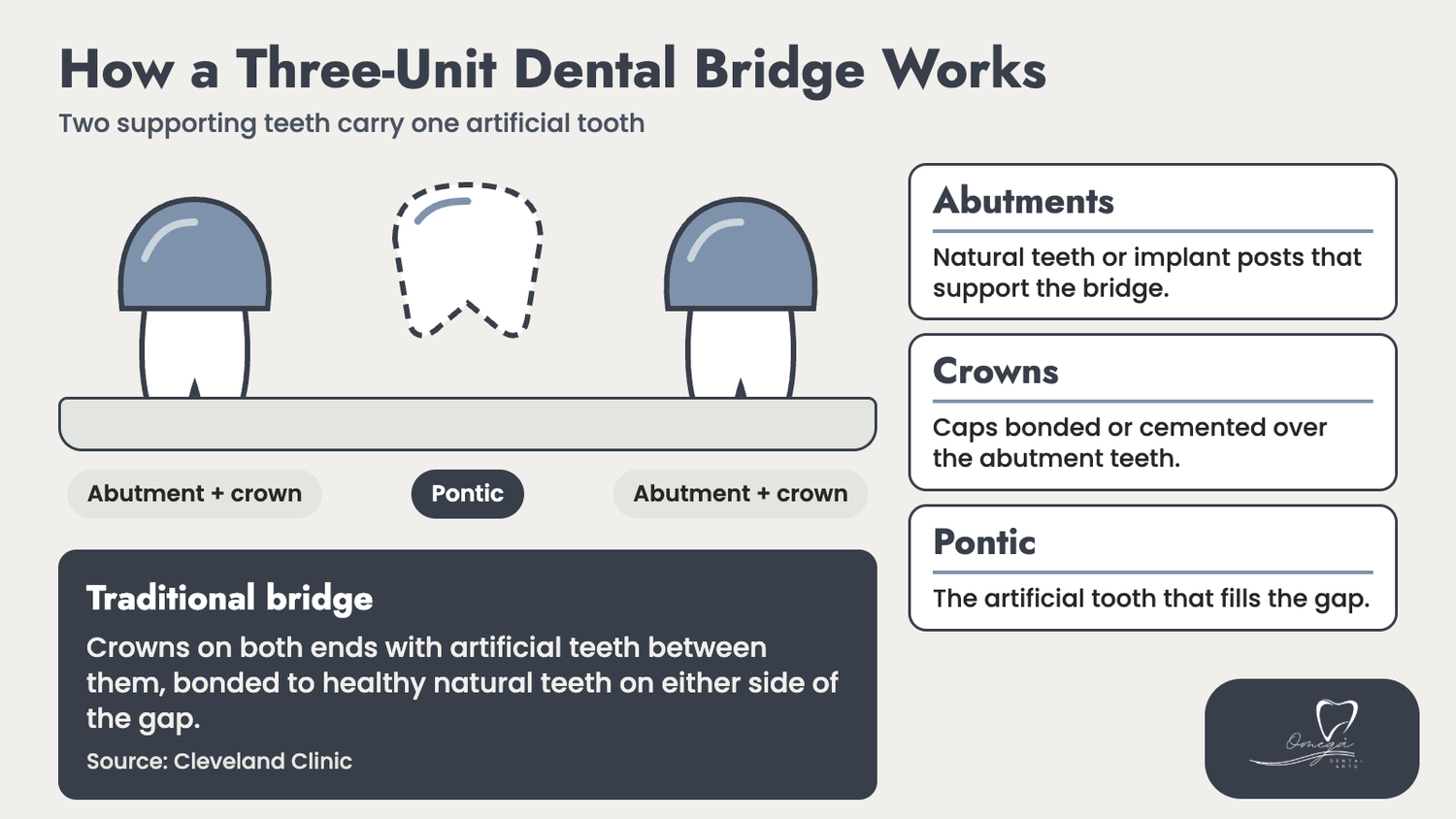
A dental bridge works by anchoring artificial teeth to the natural teeth or implants beside a gap, according to Cleveland Clinic. Cleveland Clinic names two parts in what a dental bridge contains. Abutments are the supporting structures, usually natural teeth. Pontics are the artificial teeth that fill the gap.
Understanding how a dental bridge works explains why the supporting teeth matter so much. Dentists bond crowns to the abutments, and the pontics sit between those crowns. The graphic below labels the abutment teeth, crowns and pontic.
Basic bridge facts are covered in a related post on bridge basics. The next question is what physically holds the bridge in place.
What Holds a Tooth Bridge in Place?
A tooth bridge is held in place by dental cement or resin bonding to the abutment teeth, according to Cleveland Clinic. Dentists cement traditional bridge crowns onto the natural teeth. Maryland bridges use resin cement on metal wings, and implant-supported bridges use cement or tiny screws.
healthdirect lists cement failure as a main reason bridges fail. Cement and tooth health together set how long a bridge lasts.
How Does a Dental Bridge Look?
A dental bridge looks like natural teeth because dentists match its shade to the neighboring teeth, according to Cleveland Clinic. The ADA lists gold, alloys, porcelain or a combination as bridge materials. Per healthdirect, porcelain and metals such as zirconia and gold alloy are common.
Patients can set expectations with bridge expectations from a related before-and-after post. Appearance depends partly on how many teeth the bridge replaces.
How Many Teeth Can Be Missing for a Dental Bridge?
A dental bridge can replace one to three missing teeth in a row, and sometimes up to four, according to Cleveland Clinic. The same source answers how many teeth you can put on one bridge. Four teeth need healthy natural teeth on both sides of the gap, because longer bridges need more support.
Patients who say "I need a dental bridge" can start with a count of the missing teeth. Cleveland Clinic says implant-supported bridges suit three or more missing teeth in a row. The ADA adds that bridge success depends on the foundation of remaining teeth.
How Long Does a Dental Bridge Last?
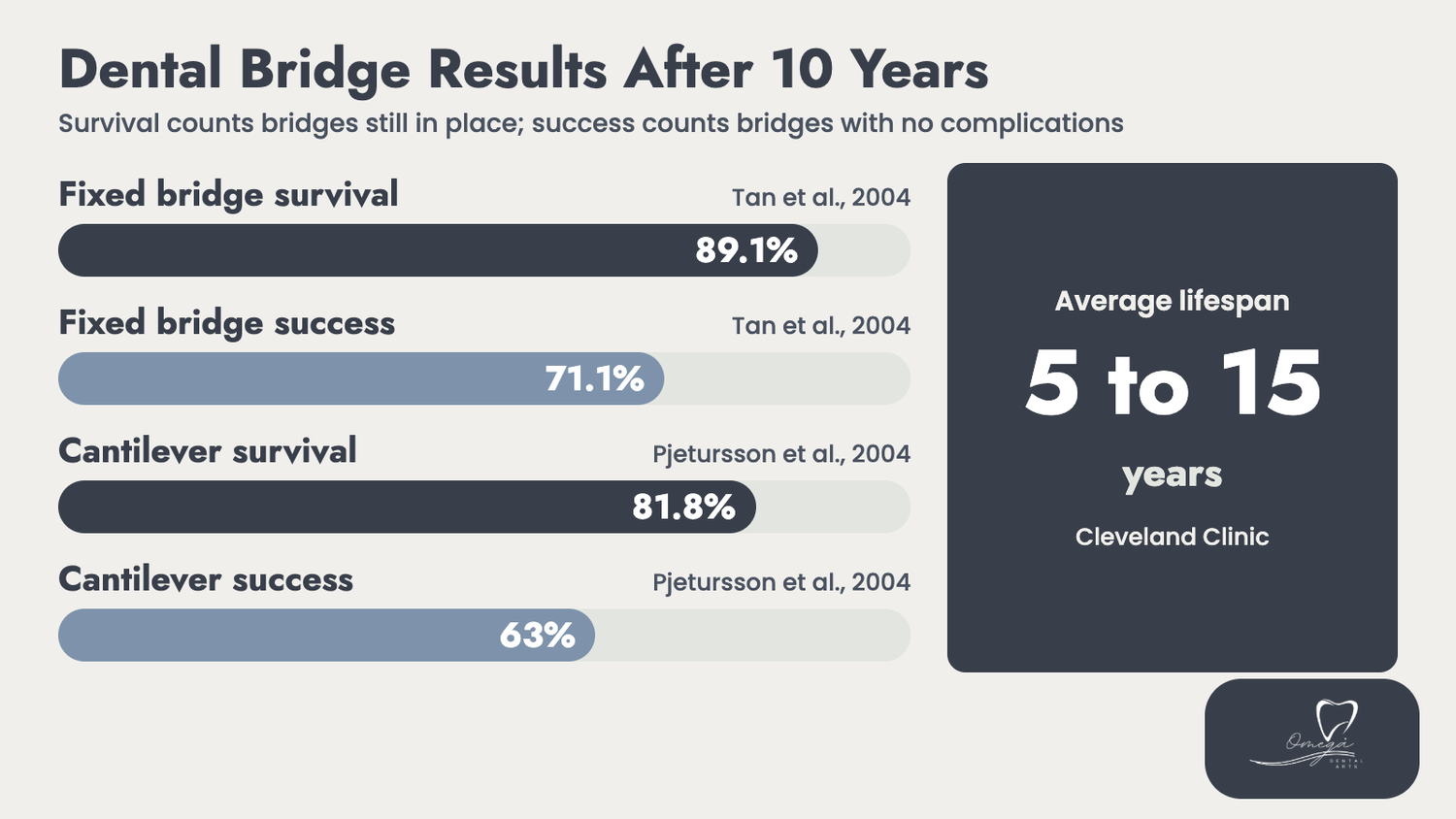
A dental bridge lasts an average of 5 to 15 years, according to Cleveland Clinic. That figure answers how many years a dental bridge will last. Cleveland Clinic adds that some bridges last longer with proper care and maintenance.
A systematic review by Tan and colleagues in Clinical Oral Implants Research followed fixed partial dentures, the clinical name for bridges. The review found 89.1% survived 10 years. Only 71.1% were free of all complications over the same period.
The table shows 10-year results from three peer-reviewed reviews.
| Restoration | 10-Year Result | Source |
|---|---|---|
| Fixed bridge | 89.1% survival, 71.1% success | Tan et al., 2004 |
| Cantilever bridge | 81.8% survival, 63% success | Pjetursson et al., 2004 |
| Implants supporting a bridge | 93.1% implant survival | Pjetursson et al., 2012 |
Survival counts a bridge still in the mouth, while success counts a bridge with no complications at all. The graphic below charts the same figures.
Those numbers lead to the most extreme lifespan question.
Can a Dental Bridge Last 25 Years?
A dental bridge lasting 25 years falls beyond the 5 to 15 year average that Cleveland Clinic reports. Cleveland Clinic adds that some bridges last longer with proper care. The Tan review measured survival at 10 years, so it does not predict 25-year results.
Daily cleaning and regular dental visits are the care steps Cleveland Clinic lists for longer bridge life. A loose bridge raises a different concern.
Will a Dental Bridge Fall Out?
A dental bridge can fall out when the cement fails or a supporting tooth breaks, according to healthdirect. The Tan review put the 10-year risk of loss of retention at 6.4%. Cleveland Clinic says a loose bridge can often be recemented.
Cleveland Clinic lists a loose bridge or visible cracks as reasons to schedule a dental visit. Patients with a loose bridge can contact our team for emergency care. Failures usually trace back to a few causes.
Why Do Dental Bridges Fail?
Dental bridges usually fail from decay in the neighboring natural teeth or from cement failure, according to healthdirect. Cleveland Clinic says damage to an abutment tooth can weaken the bridge. Weak abutment teeth can also fracture under the load.
Cleveland Clinic and healthdirect together list four failure causes for bridges.
- Decay in an abutment tooth beside the gap.
- Cement failure under a crown.
- Fracture of an abutment tooth that cannot support the load.
- Gum inflammation or cavities from plaque left under the bridge.
The Tan review measured the 10-year risks. Caries led to bridge loss in 2.6% and periodontitis in 0.7%. Abutment fracture occurred in 2.1%.
Can Teeth Rot Under a Bridge?
Teeth can rot under a bridge when plaque and bacteria stay on the gum tissue and abutment teeth, according to Cleveland Clinic. The source says poor cleaning of the bridge and the gum beneath it can cause gum inflammation or cavities. In the Tan review, caries caused 2.6% of 10-year bridge losses.
Patients can schedule hygiene visits to keep the area around the bridge clean. Cleveland Clinic recommends regular checkups and cleanings for bridge care.
What Is the Failure Rate of Dental Bridges?
The failure rate of dental bridges appears in studies as survival, and the Tan review reported 89.1% survival at 10 years. The cantilever review reported 81.8% survival at 10 years. Cantilever bridges attach on one side of the gap only.
Cleveland Clinic says cantilever bridges are not as strong as traditional bridges. Cleaning is the daily habit that supports every bridge type.
How Do You Floss a Dental Bridge?
You floss a dental bridge by passing floss under the artificial tooth with a threader. According to healthdirect, floss cannot pass between the joined crowns of a bridge. Cleveland Clinic recommends cleaning under the bridge every day with floss threaders or interproximal brushes.
The steps below combine ADA flossing technique with threader guidance from healthdirect.
- Break off about 18 inches of floss, or take a length of superfloss.
- Thread the stiff end under the bridge, between the artificial tooth and the gum.
- Pull the floss through, then curve it into a C shape against one abutment tooth.
- Slide the floss gently under the gum line and rub up and down, then repeat on the other side.
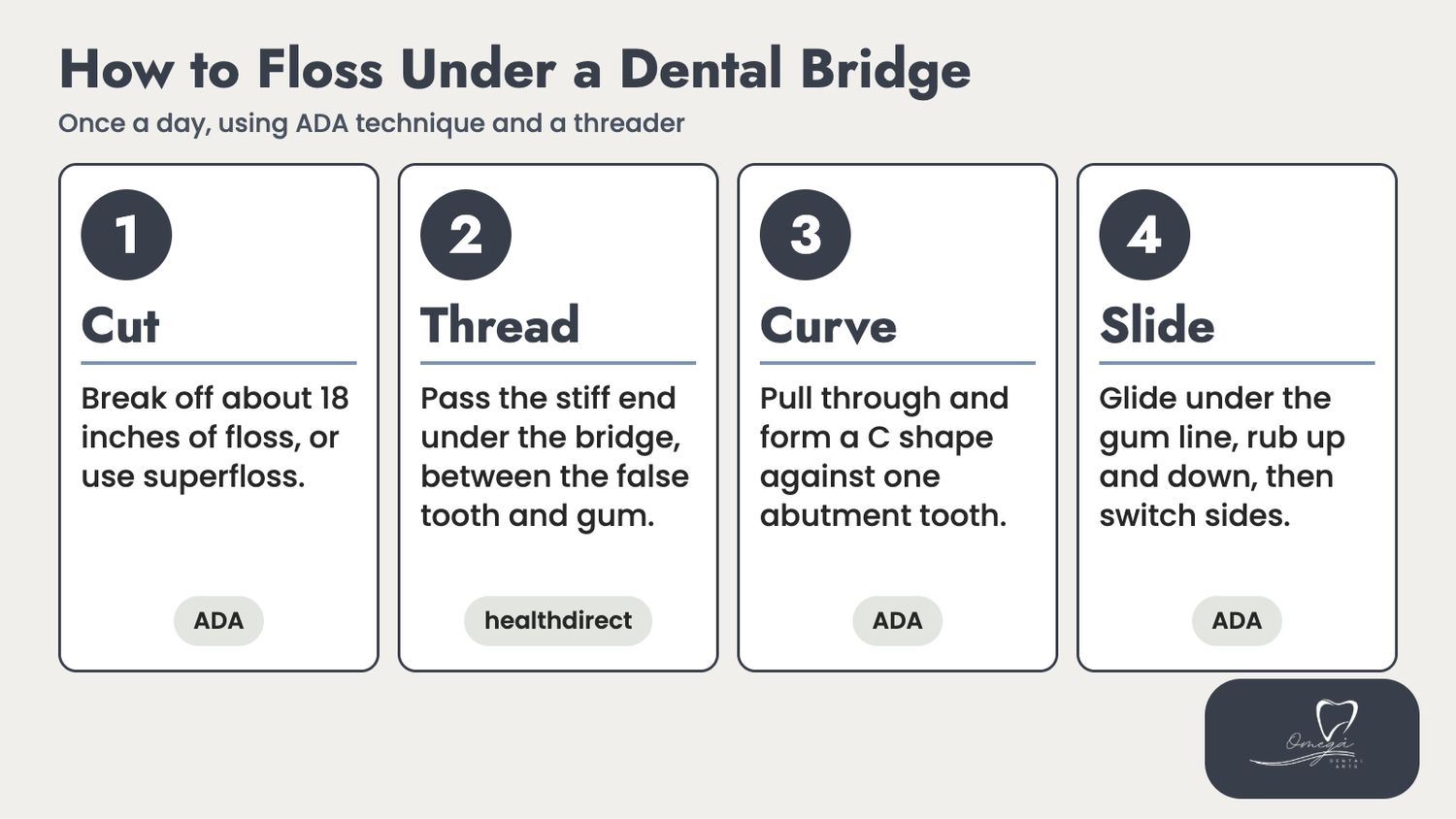
The graphic above shows the same four steps. Gentle pressure matters, because the ADA says cleaning between teeth should not cause pain.
How Often Should You Floss a Dental Bridge?
You should floss a dental bridge once a day, as the ADA recommends for removing plaque and food. Cleveland Clinic also says to clean underneath the bridge every day. The ADA says flossing before or after brushing does not matter as long as it is thorough.
The Cochrane review of 35 trials found flossing with toothbrushing may reduce gingivitis at one month. The authors rated that evidence as low certainty.
What Floss Is Used for Bridges?
Floss threaders, superfloss and interdental brushes are the tools used for bridges, according to healthdirect. The ADA also lists dental picks, tiny brushes and water flossers as safe options. The ADA suggests asking the dentist which tool suits the mouth.
Flossing products with the ADA Seal of Acceptance have been proven safe and effective, the ADA states.
Should You Use a Waterpik If You Have a Bridge?
You can use a water flosser if you have a bridge, and the ADA says it may help reach every area. A water flosser uses a gentle stream of water to rinse away food and plaque. The ADA says water flossers can be useful when other tools are hard to use.
The dentist can confirm which tool fits the bridge design.
What Happens If You Do Not Floss Under a Bridge?
Not flossing under a bridge lets plaque build up, and Cleveland Clinic says plaque and bacteria can cause gum inflammation or cavities. The ADA explains that plaque left in place can harden into tartar. Only a dentist can remove tartar.
Tartar along the gum line can lead to gum disease, according to the ADA. Daily cleaning prevents that buildup before it starts.
Is a Dental Implant More Permanent Than a Dental Bridge?
A dental implant is considered longer lasting than a dental bridge, and Cleveland Clinic says implants last much longer in general. Cleveland Clinic adds that implants also preserve existing bone. Patients with a missing tooth can ask about implant services during an exam.
The table compares the two options on time, surgery and lifespan data.
| Feature | Dental Bridge | Dental Implant |
|---|---|---|
| Time to make | About 2 to 4 weeks in the lab | 3 to 6 months to fuse with the jaw |
| Surgery | None for a traditional bridge | One surgery appointment |
| Lifespan data | 5 to 15 years average | 96.4% implant survival at 10 years |
The implant figure comes from a 2019 Journal of Dentistry review of 18 studies. The two lifespan figures measure different outcomes, so Cleveland Clinic advises talking with a dentist. Related details appear in a post on implant longevity.
Is It Better to Have a Dental Implant or a Bridge?
Whether it is better to have a dental implant or a bridge depends on the mouth, according to Cleveland Clinic. The source lists seven factors dentists consider. They are age, number of missing teeth, gap size, neighboring tooth condition, natural teeth on both sides, gum health and preferences.
A traditional bridge needs healthy natural teeth on both sides of the gap. Implant-supported bridges take longer because implants must fuse with the jaw first.
What Else Should You Know About Dental Bridges?
How Long Does a Dental Bridge Take to Be Fitted?
A dental bridge takes about two to four weeks to make and two office visits to fit, according to Cleveland Clinic. A temporary bridge is worn meanwhile. Teeth and gums heal in one to two weeks on average, and some dentists make same-day bridges with CAD/CAM technology.
Is It Painful to Have a Dental Bridge Removed?
Bridge removal is a dental procedure the dentist plans, so patients can ask about numbing first. Cleveland Clinic says dentists give local anesthesia during bridge placement. A bridge may break during removal when it comes off to treat gum disease or decay. A new bridge is then needed.
Can a Dental Bridge Be Removed and Not Replaced?
A dental bridge can be removed without replacement, but Cleveland Clinic advises replacing missing teeth as soon as possible. The source explains that neighboring teeth can shift into the gap. Patients who need extractions first may wait a few months for healing.
What Can You Get Instead of a Dental Bridge?
healthdirect lists three alternatives to a dental bridge for missing teeth.
- Partial dentures, which are removable false teeth.
- A dental implant, which replaces the tooth root.
- Crowns, which cover and protect the teeth that remain.
Patients can compare these choices with the dentist at an exam.
Is It Better to Have a Bridge or Denture?
A bridge is fixed in place, while a partial denture is removable, according to healthdirect. Partial dentures are removable false teeth that patients take out for cleaning. Patients can compare removable partials with a fixed bridge when planning treatment.
What Hurts More, a Bridge or an Implant?
A bridge procedure should not hurt because the dentist numbs the area with local anesthesia, according to Cleveland Clinic. Implant placement also uses anesthesia during an oral surgery appointment. Cleveland Clinic says implant surgery is a separate appointment from the bridge visits.
Patients curious about the implant side can read about implant pain in a related article.
Frequently Asked Questions
Are You Supposed to Floss a Bridge?
Yes, you are supposed to floss a bridge, and the ADA recommends cleaning between teeth once a day. Cleveland Clinic lists daily cleaning under the bridge as part of bridge care.
Can Food Get Stuck Under a Bridge?
Food can collect under a bridge because floss cannot pass between the joined crowns, according to healthdirect. Threaders, superfloss and interdental brushes reach that area.
What Not to Eat With a Permanent Bridge?
Cleveland Clinic advises avoiding extremely hard or chewy foods with a bridge. The same source says not to chew ice, pens, pencils or fingernails.
Is It Hard to Clean Under a Dental Bridge?
Cleaning under a dental bridge takes extra tools, according to healthdirect, because regular floss cannot pass between the joined crowns. A threader or interdental brush makes the daily step possible.
How Does Omega Dental Arts Help With Dental Bridges?
Omega Dental Arts helps with dental bridges by examining the supporting teeth, reviewing replacement options and planning treatment. Dr. Cho, Dr. Lin, Dr. Yeung and Dr. Silverman see patients at our Cherry Hill office. Patients can ask about bridge care at an exam, including cleaning routines and replacement timing.
Patients who ask is a dental bridge permanent receive a direct answer from the dentist after an exam and X-rays. The dentist reviews the abutment teeth, gums and bite before advising on lifespan. A new patient can send an appointment request to talk through options for a missing tooth.
Questions about lifespan and daily cleaning are welcome at a first visit with Omega Dental's team. The dentist explains each step in plain language and answers questions before treatment begins.